Genesis 1:27-31 NASB95
“God created man in His own image, in the image of God He created him; male and female He created them. God blessed them; and God said to them, ‘Be fruitful and multiply, and fill the earth, and subdue it; and rule over the fish of the sea and over the birds of the sky and over every living thing that moves on the earth.’ Then God said, ‘Behold, I have given you every plant yielding seed that is on the surface of all the earth, and every tree which has fruit yielding seed; it shall be food for you; and to every beast of the earth and to every bird of the sky and to every thing that moves on the earth which has life, I have given every green plant for food’; and it was so. God saw all that He had made, and behold, it was very good. And there was evening and there was morning, the sixth day.”
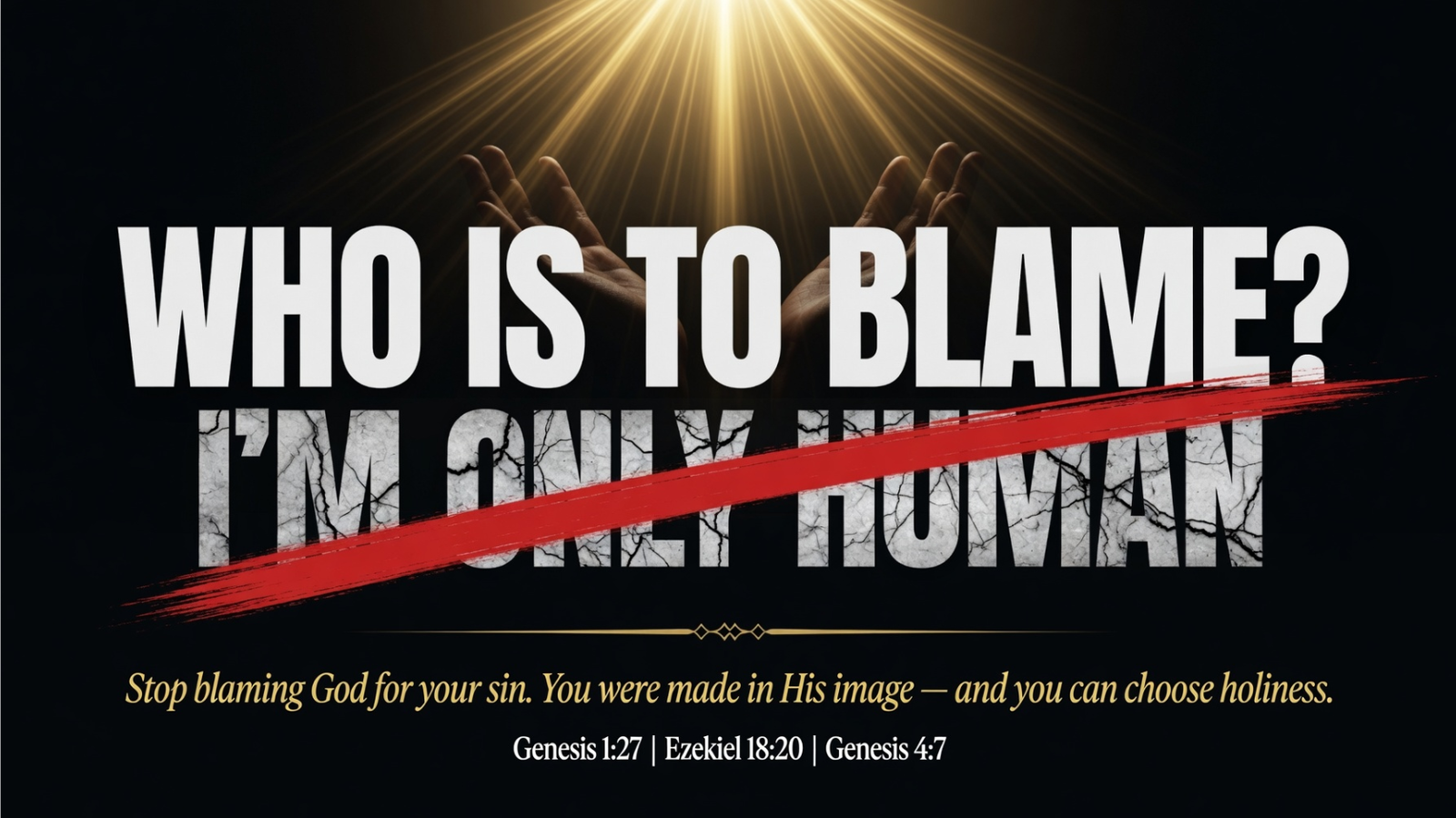
The Bible opens with a clear declaration that God made mankind in His own image and that everything He made was very good. That is the starting point of the human story. Yet many who claim to follow Christ still place the blame for all the sin we see today on Adam and Eve, teaching that we inherit a sinful nature from them. That idea has shaped large parts of the religious world.
There is another idea that has grown more common, often without people noticing. It has been colored by the doctrine of inherited sin, but it goes a step further. It points past Adam and places the blame on the Creator Himself. It plants doubt about whether we can truly obey God or follow the example of Christ. You hear it in statements meant to comfort the guilty: “We’re all just people.” “Everyone sins from time to time.” “I was born this way.” “I’m only human.”
These phrases sound humble. They are not.
I. “I’m Only Human” Places the Blame on God
When someone says, “I’m only human,” we must ask what is meant. Is it simply an acknowledgment of physical limits—that we grow tired, that we cannot lift a certain weight, or that we live in a fallen physical world? Or is it offered as an excuse for sin—letting anger rule the heart, speaking harshly, or choosing what we know is wrong because of a bad day, a disappointing grade, or trouble among friends?
We need to think carefully about what we are really saying. When we blame our human nature for the sins we commit, we are not pointing to Adam the way Calvinists do. We are not even saying the devil made us do it. We are placing the responsibility on the One who made us.
Follow the logic backward. “I am only human” points to what we are. Then we must ask: From whom did we descend? We descended from Adam and we do suffer certain consequences of his sin, such as physical death. Yet God said through Ezekiel, “The person who sins will die. The son will not bear the punishment for the father’s iniquity, nor will the father bear the punishment for the son’s iniquity; the righteousness of the righteous will be upon himself, and the wickedness of the wicked will be upon himself” (Ezekiel 18:20 NASB95). He also said to Jeremiah, “Before I formed you in the womb I knew you” (Jeremiah 1:5 NASB95).
God does the creating. He does not create sinners—neither in Genesis nor when a child is conceived and a soul is given. Each person answers for his own actions.
Some raise Psalm 51:5 and Romans 5:12-19 as evidence that we inherit either Adam’s guilt or a nature that makes sin inevitable. We need to look carefully at what those passages actually say.
In Psalm 51 David is pouring out a deeply personal confession after his sin with Bathsheba. He writes, “Behold, I was brought forth in iniquity, and in sin my mother conceived me” (Psalm 51:5 NASB95). The entire psalm is about *his* transgressions, *his* sin, and *his* need for cleansing. The language is intense and poetic, the language of a man crushed by the weight of his own guilt. It is not a systematic statement that every child inherits Adam’s personal guilt. Scripture elsewhere is crystal clear that God does not transfer the guilt of the father to the child (Ezekiel 18:20). David’s words express the depth of his own sense of sinfulness; they do not overturn the principle of individual responsibility taught throughout the rest of the Bible.
Romans 5:12-19 is the other passage most often cited. Paul writes, “Therefore, just as through one man sin entered into the world, and death through sin, and so death spread to all men, because all sinned—” (Romans 5:12 NASB95). Notice the final clause carefully: death spread to all men *because all sinned*. The text does not say death spread to all men simply because they were in Adam, regardless of their own actions. Adam introduced sin and its consequence—death—into the world. Every accountable person has followed him in choosing to sin, and that is why death has spread. Paul is drawing a powerful parallel between Adam and Christ: one man’s disobedience brought condemnation, one Man’s obedience brings justification. Yet even in the parallel Paul is careful to show differences. The passage teaches the entrance of sin and death through Adam and the entrance of justification and life through Christ. It does not teach that infants are born already guilty of Adam’s personal sin or that human nature itself forces us to sin.
Physical death is a real consequence that affects the entire human family because of Adam. Spiritual death and condemnation come through our own willing choices. That distinction preserves both the justice of God and the clear teaching of personal responsibility found from Genesis to Revelation.
If our sins are not the result of inheriting guilt from Adam, the next question is unavoidable: Who created Adam? Genesis answers plainly. God made man in His image (Genesis 1:26), and everything He made was very good (Genesis 1:31). God gave us human nature. Therefore we cannot excuse ourselves by saying, “I’m only human.”
Many well-meaning brethren do not intend to blame God when they use that language. Still, the fact remains that we are made in His image. To claim that we sin because we are human is, at best, an ignorant slap at God’s character. At worst, it is blasphemy. A just God cannot command what is impossible and then condemn us for failure. Scripture declares, “The Rock! His work is perfect, for all His ways are just; a God of faithfulness and without injustice, righteous and upright is He” (Deuteronomy 32:4 NASB95). If human nature itself made obedience impossible, then God would be unjust for requiring it and for judging us when we fall short.
Consider the first human pair after the fall. God spoke to Cain and said, “If you do well, will not your countenance be lifted up? And if you do not do well, sin is crouching at the door; and its desire is for you, but you must master it” (Genesis 4:7 NASB95). God told Cain he could master the sin that crouched at the door. That statement makes no sense if human nature itself rendered obedience impossible.
II. God Commands What We Are Able to Do
Throughout Scripture, God’s consistent concern is that man be holy. He never issues moral commands that lie beyond our capacity.
“For I am the Lord your God. Consecrate yourselves therefore, and be holy, for I am holy” (Leviticus 11:44 NASB95).
“You shall consecrate yourselves therefore and be holy, for I am the Lord your God” (Leviticus 20:7 NASB95).
“Thus you are to be holy to Me, for I the Lord am holy; and I have set you apart from the peoples to be Mine” (Leviticus 20:26 NASB95).
“But like the Holy One who called you, be holy yourselves also in all your behavior; because it is written, ‘You shall be holy, for I am holy’” (1 Peter 1:15-16 NASB95).
“Pursue peace with all men, and the sanctification without which no one will see the Lord” (Hebrews 12:14 NASB95).
“Therefore, having these promises, beloved, let us cleanse ourselves from all defilement of flesh and spirit, perfecting holiness in the fear of God” (2 Corinthians 7:1 NASB95).
“Therefore you are to be perfect, as your heavenly Father is perfect” (Matthew 5:48 NASB95).
These are not suggestions. They are commands. God does not command the impossible. Moses told Israel, “For this commandment which I command you today is not too difficult for you, nor is it out of reach. It is not in heaven… nor is it beyond the sea… But the word is very near you, in your mouth and in your heart, that you may observe it” (Deuteronomy 30:11-14 NASB95). The same principle holds under the new covenant.
James shows where sin actually comes from: “Let no one say when he is tempted, ‘I am being tempted by God’; for God cannot be tempted by evil, and He Himself does not tempt anyone. But each one is tempted when he is carried away and enticed by his own lust. Then when lust has conceived, it gives birth to sin; and when sin is accomplished, it brings forth death” (James 1:13-15 NASB95). Desire arises, a choice is made, and sin is born. The problem is not the nature God gave us; the problem is the choice we make.
Paul adds a further assurance: “No temptation has overtaken you but such as is common to man; and God is faithful, who will not allow you to be tempted beyond what you are able, but with the temptation will provide the way of escape also, so that you will be able to endure it” (1 Corinthians 10:13 NASB95). God never leaves us without a way of escape. That promise would be empty if our nature made resistance impossible.
Jesus Himself lived as a man, “who has been tempted in all things as we are, yet without sin” (Hebrews 4:15 NASB95). He shared our nature yet never sinned. That fact alone shows that human nature is not the root cause of sin.
III. Men Do Sin—By Willing Choice
The fact that men sin is obvious. We often quote Romans 3:23 NASB95—“for all have sinned and fall short of the glory of God”—or 1 John 1:8 NASB95—“If we say that we have no sin, we are deceiving ourselves and the truth is not in us.” These verses observe a universal fact. They do not teach that sin is the necessary result of the human condition. They record what men have chosen to do, not what they were forced to do by nature.
John writes, “My little children, I am writing these things to you so that you may not sin. And if anyone sins, we have an Advocate with the Father, Jesus Christ the righteous” (1 John 2:1 NASB95). The goal is that we may not sin. The provision for forgiveness exists because we sometimes choose poorly, not because we cannot choose otherwise.
The difference between “human nature made me do it” and “I chose to do it” is not small. This life is already hard enough without God’s people believing the lie that failure is inevitable. We need to understand that we can do what God asks. Our brethren can do it. God called us to do it. We must do it—be different from the world and be like Him.
Let’s stop blaming God for our sins. Do not blaspheme His holy name by implying that He made us incapable of the very obedience He requires. If we do sin, He will forgive us when we are penitent and obedient. But we cannot truly be penitent while we blame the human nature He gave us.
Those who want forgiveness must believe the word (Hebrews 11:6; Romans 10:17), confess Christ (Matthew 10:32), repent and be baptized for the forgiveness of sins (Acts 2:38), and then live faithfully (James 1:12). Christians who sin must confess and repent (1 John 1:9; Psalm 32:5; Proverbs 28:13).
Conclusion:
We can be good. We can live up to the expectations God has given us. He would not ask us to if we could not. He provides forgiveness when we choose to rebel, yet He also teaches that we do not have to rebel and that we should not.
We help others far more with the truth than with a comforting lie. Tell them they can overcome. Tell them God made them capable. If you do sin, repent and continue faithfully. That is part of being faithful. But never believe that you lack the ability to master sin. God made you in His image, and that means something.
Leave a Reply