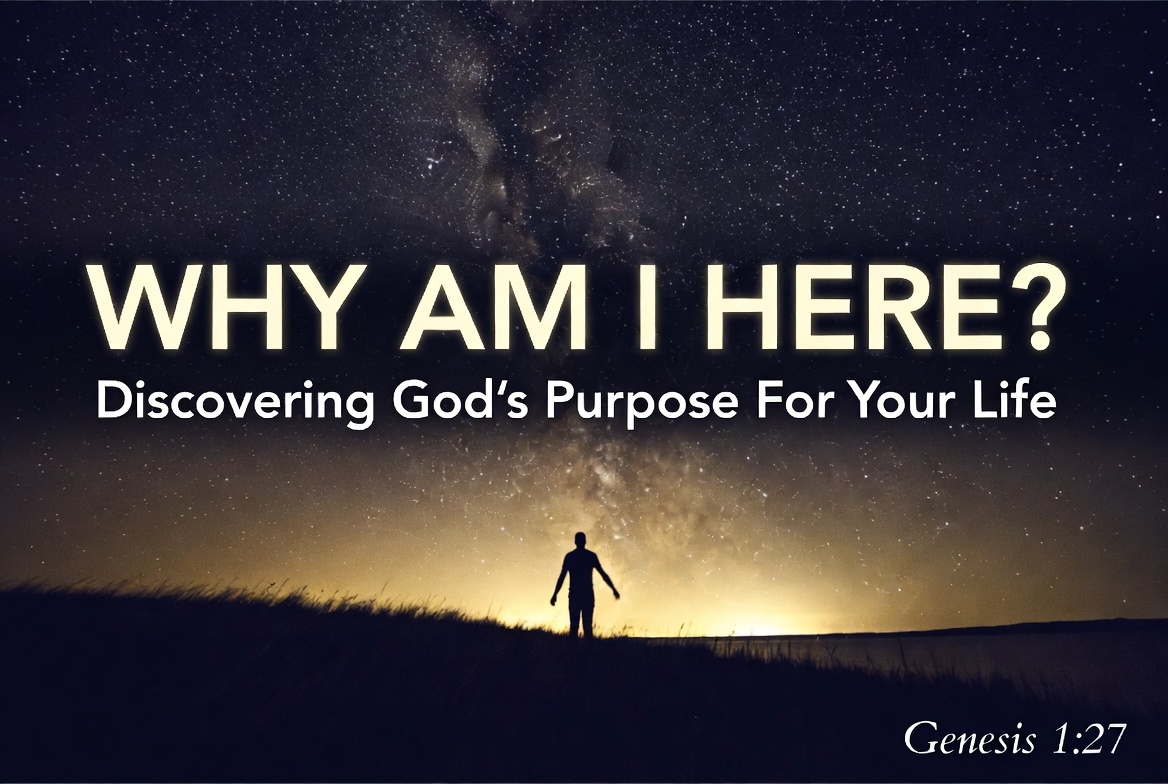
Everyone asks these questions at some point: Where did I come from? Why am I here? Most of us have wondered about our origins and our purpose. The Bible gives us clear, trustworthy answers straight from God.
We are here because God made us on purpose. Genesis 1:1 opens with, “In the beginning God created the heavens and the earth.” Then Genesis 1:27 adds, “So God created man in His own image; in the image of God He created him; male and female He created them.” God made us in His likeness. Genesis 1:31 says He looked at everything He had made and saw that “it was very good.”
Many people today say everything came from nothing through a big explosion. But that leaves the same problem: Where did the stuff come from that exploded? If you had a car wreck and flipped five times, you would never say a mosquito caused it. That is not enough cause for the effect. The same is true for the universe. Everything that has a beginning needs a sufficient cause, and God is that cause.
Look around you. If you found a brand-new laptop lying on the beach, you would know someone made it. You would not say it just appeared out of nowhere. Our world is far more complex than any computer. The sun, stars, mountains, and even our own bodies show careful design. Something designed must have a Designer. Romans 1:20 explains it well: “For since the creation of the world His invisible attributes are clearly seen, being understood by the things that are made, even His eternal power and Godhead, so that they are without excuse.”
We also see beauty everywhere. Have you watched a sunrise or sunset paint the sky? Animals do not stop to enjoy it the way we do. Genesis 1:16 says simply, “He made the stars also.” When you learn that the nearest star is about twenty-four trillion miles away, you realize only God could have done that. Beauty points to a Creator who cares about more than just survival.
We know right from wrong deep inside us. Everyone agrees that some things are always wrong: murder, rape, racism. If there were no God, who would decide what is right? We would each make our own rules, and might would make right. But we know better. Hitler broke no German law when he did what he did, yet the whole world knew it was wrong. That higher moral law comes from God. Galatians 3:28 says, “There is neither Jew nor Greek…for you are all one in Christ Jesus.” Acts 17:26 adds that God “has made from one blood every nation of men.” We are all equal before Him.
God tells us why He put us here. Acts 17:26-27 says He “has made from one blood every nation of men to dwell on all the face of the earth, and has determined their preappointed times and the boundaries of their dwellings, so that they should seek the Lord, in the hope that they might grope for Him and find Him, though He is not far from each one of us.” We are here to seek God and to know Him. We are here to glorify Him. First Corinthians 6:19-20 reminds us, “You are not your own. For you were bought at a price; therefore glorify God in your body and in your spirit, which are God’s.”
God does not need us. Acts 17:25 says He is “not worshiped with men’s hands, as though He needed anything.” He is like a parent who has children because he wants to love them and be loved in return. God wants us to be with Him forever in heaven.
If you want to fulfill the purpose God gave you, start today. Hear the gospel, believe in Jesus, repent of your sins, confess Him as the Son of God, and be baptized for the remission of sins. Acts 2:38 says, “Repent, and let every one of you be baptized in the name of Jesus Christ for the remission of sins; and you shall receive the gift of the Holy Spirit.” Then live faithful to Him every day. Revelation 2:10 promises, “Be faithful until death, and I will give you the crown of life.”
We do not have to wonder why we are here. God made us in His image, put us here to seek Him, and offers us eternal life with Him. That truth gives every day real meaning. Will you seek the Lord today? He is not far from you.
In an age of religious diversity, where human traditions and ecclesiastical authorities often overshadow divine revelation, the timeless principle of Sola Scriptura reminds us to anchor our beliefs solely in God’s written word. As Paul emphasized to Timothy, Scripture equips us fully for every aspect of godly living, rendering unnecessary any supplementary sources or exclusive clerical guidance. Today we will explore the inspiration and completeness of the canon, the accessibility of Scripture to all believers, its comprehensive sufficiency, and responses to common challenges.
The Inspiration and Completeness of the Biblical Canon:
The Bible’s sixty-six books represent the full canon of inspired writings, excluding uninspired additions like the Apocrypha. These apocryphal books were absent from the original Hebrew Scriptures, lacked endorsement by Christ or New Testament authors, and fail to demonstrate divine inspiration through consistent doctrine or fulfilled prophecy. They often contradict the divine harmony seen across the Bible’s unified message despite its composition by over forty different men over fifteen hundred years. Scripture itself warns against altering its content. “You shall not add to the word which I command you, nor take from it, that you may keep the commandments of the Lord your God which I command you.” (Deuteronomy 4:2, NKJV) “For I testify to everyone who hears the words of the prophecy of this book: If anyone adds to these things, God will add to him the plagues that are written in this book; and if anyone takes away from the words of the book of this prophecy, God will take away his part from the Book of Life, from the holy city, and from the things which are written in this book.” (Revelation 22:18-19, NKJV)
Some claim the church gave us the Bible or that the Bible has no inspired table of contents. Yet the truth is simple: God gave us the Bible. He inspired every book through the Holy Spirit. The early church, guided by miraculous gifts of the Spirit that confirmed the apostles’ teaching, simply recognized what God had already made. They did not create the canon; they acknowledged it. Even before later councils met, the books were already widely accepted among believers. Around A.D. 310, Eusebius noted twenty-one undisputed books and six that most accepted though some disputed them. The Old Testament books used by the Jews were already settled in the time of Christ.
Christ and the apostles affirmed the Old Testament canon while the New Testament completes God’s revelation. Jesus referenced the Law, Prophets, and Psalms as authoritative and fulfilled in Him. “Then He said to them, ‘These are the words which I spoke to you while I was still with you, that all things must be fulfilled which were written in the Law of Moses and the Prophets and the Psalms concerning Me.’” (Luke 24:44, NKJV) Peter classified Paul’s epistles alongside other Scriptures, confirming the canon’s unity. “…as also our beloved brother Paul, according to the wisdom given to him, has written to you, as also in all his epistles, speaking in them of these things, in which are some things hard to understand, which untaught and unstable people twist to their own destruction, as they do also the rest of the Scriptures.” (2 Peter 3:15-16, NKJV)
The divine harmony of Scripture further proves its inspiration and completeness. Though written by many different men across centuries, the Bible never truly contradicts itself when we study it carefully and compare passage with passage. Instead, one part explains, supports, and completes another. God teaches us to build truth gradually, letting Scripture interpret Scripture. “For precept must be upon precept, precept upon precept, Line upon line, line upon line, Here a little, there a little.” (Isaiah 28:10, NKJV) The Holy Spirit guided the writers to speak in perfect agreement. “These things we also speak, not in words which man’s wisdom teaches but which the Holy Spirit teaches, comparing spiritual things with spiritual.” (1 Corinthians 2:13, NKJV) From Genesis to Revelation, the Bible tells one unbroken story of God’s plan to save mankind through Jesus Christ, with every book fitting together like pieces of a perfect puzzle. The Old Testament points forward to Christ. “And beginning at Moses and all the Prophets, He expounded to them in all the Scriptures the things concerning Himself.” (Luke 24:27, NKJV) The New Testament shows how those promises are fulfilled, completing the message without clash or confusion. “You search the Scriptures, for in them you think you have eternal life; and these are they which testify of Me.” (John 5:39, NKJV)
Upholding the canon’s completeness safeguards against doctrinal dilution and ensures reliance on God’s unaltered message.
The Accessibility of Scripture to Every Believer:
The Bible is crafted for ordinary individuals, not an elite priesthood, allowing direct comprehension of God’s will. Paul encouraged believers to understand through personal reading, without mandatory intermediaries. “…when you read, you may understand my knowledge in the mystery of Christ…” (Ephesians 3:4, NKJV) “Therefore do not be unwise, but understand what the will of the Lord is.” (Ephesians 5:17, NKJV) New Testament letters were directed to common Christians, assuming their ability to grasp and apply the truths contained therein.
Historical and biblical evidence demonstrates Scripture’s reach even amid challenges like limited literacy or resources. Commands to meditate on God’s word presume accessibility for all. “This Book of the Law shall not depart from your mouth, but you shall meditate in it day and night, that you may observe to do according to all that is written in it. For then you will make your way prosperous, and then you will have good success.” (Joshua 1:8, NKJV) Early Christians copied, memorized, and obeyed Scripture, spreading the gospel effectively without modern conveniences, as evidenced by rapid church growth in Acts.
Embracing Scripture’s clarity promotes personal responsibility and spiritual maturity, countering claims of exclusive interpretive authority.
The Sufficiency of Scripture for Faith and Practice:
The Bible furnishes all essentials for salvation, worship, and moral living, obviating the need for evolving traditions. It grants everything required for life and godliness. “…as His divine power has given to us all things that pertain to life and godliness, through the knowledge of Him who called us by glory and virtue…” (2 Peter 1:3, NKJV) Adding to or altering the gospel invites condemnation. “But even if we, or an angel from heaven, preach any other gospel to you than what we have preached to you, let him be accursed. As we have said before, so now I say again, if anyone preaches any other gospel to you than what you have received, let him be accursed.” (Galatians 1:8-9, NKJV)
Scripture prohibits exceeding its teachings, fostering unity through adherence to its directives. It comprehensively covers doctrine and conduct. “Now these things, brethren, I have figuratively transferred to myself and Apollos for your sakes, that you may learn in us not to think beyond what is written, that none of you may be puffed up on behalf of one against the other.” (1 Corinthians 4:6, NKJV) Deviations arise from human desires to evade biblical authority, but restoration comes through returning to Scripture alone.
Scripture’s sufficiency provides stability against subjective dogmas, guiding believers to eternal truth.
Addressing Common Objections to Sola Scriptura:
The absence of widespread printing before the fifteenth century did not hinder access, as copying, memorization, and oral teaching disseminated truth effectively. Early church fathers and even critics quoted extensively from Scripture, proving its availability. Thousands obeyed without modern tools, as the gospel’s power transcended such limitations. “Then those who gladly received his word were baptized; and that day about three thousand souls were added to them.” (Acts 2:41, NKJV) “However, many of those who heard the word believed; and the number of the men came to be about five thousand.” (Acts 4:4, NKJV)
Claims of widespread illiteracy ignore that non-readers could still learn through faithful teaching, and archaeology shows literacy in ancient cultures. Jesus, from humble origins, read publicly. “So He came to Nazareth, where He had been brought up. And as His custom was, He went into the synagogue on the Sabbath day, and stood up to read. And He was handed the book of the prophet Isaiah. And when He had opened the book, He found the place where it was written: ‘The Spirit of the Lord is upon Me, Because He has anointed Me To preach the gospel to the poor; He has sent Me to heal the brokenhearted, To proclaim liberty to the captives And recovery of sight to the blind, To set at liberty those who are oppressed; To proclaim the acceptable year of the Lord.’ Then He closed the book, and gave it back to the attendant and sat down. And the eyes of all who were in the synagogue were fixed on Him. And He began to say to them, ‘Today this Scripture is fulfilled in your hearing.’” (Luke 4:16-21, NKJV) Apostles like Peter and John contributed written works despite modest backgrounds. The same objection could apply to understanding clerical dogmas, highlighting the inconsistency.
Assertions that ordinary people lack critical skills for interpretation overlook Scripture’s call for diligent study by all. “Be diligent to present yourself approved to God, a worker who does not need to be ashamed, rightly dividing the word of truth.” (2 Timothy 2:15, NKJV) No advanced scholarship is required for salvation’s basics; the Bible’s plain truths suffice. History confirms that departures from Scripture stem from rejecting its authority, not from inherent inaccessibility.
Conclusion:
Sola Scriptura declares the Bible as inspired, complete, accessible, and sufficient—our unwavering guide without rivals. Commit to its study and obedience, finding therein the assurance of salvation.
If you remain outside Christ’s fold, obey the gospel: believe in Him. “Therefore I said to you that you will die in your sins; for if you do not believe that I am He, you will die in your sins.” (John 8:24, NKJV) Repent. “Truly, these times of ignorance God overlooked, but now commands all men everywhere to repent…” (Acts 17:30, NKJV) Confess Him. “…if you confess with your mouth the Lord Jesus and believe in your heart that God has raised Him from the dead, you will be saved. For with the heart one believes unto righteousness, and with the mouth confession is made unto salvation.” (Romans 10:9-10, NKJV) And be baptized for sin’s remission. “Then Peter said to them, ‘Repent, and let every one of you be baptized in the name of Jesus Christ for the remission of sins; and you shall receive the gift of the Holy Spirit.’” (Acts 2:38, NKJV) Wayward saints, confess and seek forgiveness. “If we confess our sins, He is faithful and just to forgive us our sins and to cleanse us from all unrighteousness.” (1 John 1:9, NKJV)
1 Corinthians 5:6-7 NKJV “Your glorying is not good. Do you not know that a little leaven leavens the whole lump? Therefore purge out the old leaven, that you may be a new lump, since you truly are unleavened. For indeed Christ, our Passover, was sacrificed for us.”
God demands that His church remain holy and faithful. When a brother or sister persists in unrepented sin, the Bible commands us to act. This is church discipline. It’s not optional or cruel, it’s obedience to God, driven by love for the sinner and zeal for the purity of the body of Christ.
The Lord Jesus Himself gave the exact steps in Matthew 18:15-17 NKJV:
“Moreover if your brother sins against you, go and tell him his fault between you and him alone. If he hears you, you have gained your brother. But if he will not hear, take with you one or two more, that by the mouth of two or three witnesses every word may be established. And if he refuses to hear them, tell it to the church. But if he refuses even to hear the church, let him be to you like a heathen and a tax collector.”
We must follow these steps precisely.
I. The Steps God Commands
Begin privately. Go to the person alone and confront the sin with clear Scripture. Speak with gentleness but firmness. Galatians 6:1 NKJV instructs, “Brethren, if a man is overtaken in any trespass, you who are spiritual restore such a one in a spirit of gentleness, considering yourself lest you also be tempted.” The aim is restoration and salvation.
If the sinner refuses to repent, take one or two faithful witnesses. This upholds the principle of Deuteronomy 19:15 NKJV: “by the mouth of two or three witnesses every word may be established.”
If the person still will not listen, bring the matter before the whole church. The congregation, and the church at large (We will discuss church hoppers in another article at a later time) must act as one body under Christ’s authority.
If the sinner refuses even the church’s call to repent, the church must withdraw fellowship. Paul commands in 2 Thessalonians 3:6 NKJV: “But we command you, brethren, in the name of our Lord Jesus Christ, that you withdraw from every brother who walks disorderly and not according to the tradition which he received from us.” He adds in 1 Corinthians 5:11 NKJV: “But now I have written to you not to keep company with anyone named a brother, who is sexually immoral, or covetous, or an idolater, or a reviler, or a drunkard, or an extortioner—not even to eat with such a person.”
This withdrawal is purposeful: “note that person and do not keep company with him, that he may be ashamed. Yet do not count him as an enemy, but admonish him as a brother” (2 Thessalonians 3:14-15 NKJV). Shame can lead to repentance and salvation.
II. Why We Must Obey This Command
Discipline protects the sinner and the church. In 1 Corinthians 5, Paul ordered the Corinthian church to deliver the immoral man “to Satan for the destruction of the flesh, that his spirit may be saved in the day of the Lord Jesus” (1 Corinthians 5:5 NKJV). The goal is always the soul’s salvation.
Sin spreads like leaven. Paul warns, “Do you not know that a little leaven leavens the whole lump?” (1 Corinthians 5:6 NKJV). If we tolerate open sin, it corrupts the entire body. Christ desires His church spotless, “not having spot or wrinkle or any such thing, but that she should be holy and without blemish” (Ephesians 5:27 NKJV). We must purge sin to keep the church pure and faithful.
III. The Severe Consequences of Refusing to Act
When churches refuse to discipline sin, they disobey God and invite judgment. The Lord rebuked the church in Thyatira: “But I have a few things against you, because you allow that woman Jezebel, who calls herself a prophetess, to teach and seduce My servants to commit sexual immorality and eat things sacrificed to idols” (Revelation 2:20 NKJV). Because they tolerated sin, Christ threatened severe consequences unless they repented.
The same danger exists today. Untreated sin spreads, weak members stumble, the church’s reputation to the world is damaged or destroyed, and Christ’s name is dishonored. God warned the Ephesian church, “Remember therefore from where you have fallen; repent and do the first works, or else I will come to you quickly and remove your lampstand from its place—unless you repent” (Revelation 2:5 NKJV). Refusal to discipline can lead to the removal of the church’s lampstand and the souls involved to be tainted with sin before God just the same as the originator of the problem.
Paul’s question is just as relevant today: “Do you not know that a little leaven leavens the whole lump?” (1 Corinthians 5:6 NKJV). To ignore this command is to claim wisdom above God’s. The result is spiritual ruin for individuals and the congregation.
CONCLUSION
Church discipline is a direct command from Christ and His apostles. We must follow every step exactly as Scripture directs. We must act with love, prayer, and unwavering commitment to truth, always seeking the sinner’s repentance and restoration.
We must be faithful in this matter. We must love our brethren enough to confront sin when it arises. We must keep the church pure as God demands. Obedience brings salvation to souls and honor to Christ. Refusal brings corruption and divine displeasure.
The faithful receive the crown of life: “Blessed is the man who endures temptation; for when he has been approved, he will receive the crown of life which the Lord has promised to those who love Him” (James 1:12 NKJV).
Every congregation must obey God’s word in this vital duty. The purity of the church and the salvation of souls depend on it.
The fundamental reason for the study of this topic lies within the reality that self claims for inspiration are made by many books in circulation today. For example the book of Mormon, the Koran, and several other writings have made the claim to be from God, so how do we know what to believe?
First of all if we can establish that the Bible is the divinely inspired word of God then it by necessity eliminates the other writings based upon passages such as Deuteronomy 4:2, Revelation 22:19, and Galatians 1:8. In a certain sense it is related to Canonicity in as much as only inspired books are accepted as canon however the focus will be on proving that the bible is inspired as a whole rather than an individual book. In A General Introduction To The Bible by Norman L. Geisler and William E. Nix the statement is made and is written as follows in Chapter 11, “…as to whether or not the Bible is the Word of God is a matter of evidence. After all, there are other books, such as the Koran and the book of Mormon, that claim to be the Word of God, and yet they contradict the Bible.”
INTRODUCTION TO THE TOPIC
To open this brief study into the subject of inspiration we will consider the two types of evidence that exist concerning inspiration. The first is external evidence and is only pertinent to this short study since we need to understand what is and what is not internal evidence which is the second. External evidences are usually considered things such as historical data on events or people in the Bible that lend credibility to the Bible itself as being accurate, also archaeology will usually fall into this category. There are times when the external evidence and internal will overlap with one another, such as what is often called scientific foreknowledge found inside the text of the bible itself and verified by the external evidence, but we will do our best to focus on the internal evidences and only mention things outside of that when it is pertinent to understanding or clarifying a point that needs to be made for the subject at hand.
A LOOK AT SEVERAL TYPES OF INTERNAL EVIDENCE
There are several types of internal evidences that should be discussed when one considers the question “Is the bible from God?”, some will be direct claims while others will require logical inference. We will consider several things such as “Unity of the bible”, the facts concerning how many men were involved in writing the bible and how many years over which the writing took place, the nature of impartiality of the bible or how it does not show the typical signs of a bias that man made writings have, the scientific foreknowledge found in scripture, the endorsement of books that aren’t as easily demonstrated as being inspired than others at face value as others that are more easily shown to be inspired in the Old testament and the same within the New Testament, the fulfillment of prophecy, and certain examples of factual accuracy when pertinent.
THE BIBLE’S UNITY
One Subject more often discussed than many of the others listed in the introduction is that of the unity of the bible in message and harmony. It is fairly common knowledge, relatively speaking ,that the bible was written over a period of roughly sixteen hundred years and by more than forty men. The main theme of the bible becomes clearer as one moves from the beginning books of scripture to the final book of revelation, the theme of man’s fall and redemption through Christ Jesus and the hope and reward of Heaven that waits to those that are faithful. This type of evidence for inspiration of the bible touches on subjects such as prophecy and mutual endorsement of scripture by different writers in different books and even during different dispensations such as the New Testament verifying the Old Testament by quoting or referring to passages as scripture. The Lord Himself even quoting scripture as inspired or God breathed. God’s Prophetic Word by Foy E. Wallace states, “The consistent harmony in the contents of the old and the new testaments is an element of inspiration which critics can not deny.” He continues to say on in the next section, “The prophets of the Old testament did not understand what they prophesied, but they all spoke and wrote in agreement without discrepancy in the facts of the life, of the death and of the reign of the Messiah to come.” (11,12). He writes again later on that same page, “The writers of the New Testament were in perfect agreement on what the writers of the Old Testament meant. The old is understood in the light of the new.” and he emphasizes that by saying, “There is never the slightest disagreement among the writers of the New Testament in reference to the meaning or the application of an Old Testament prophecy or statement.” (12).
THE BIBLE’S IMPARTIALITY
Another evidence of inspiration is that when one reads writings from any other book he or she can begin to notice a certain romanticism of characters or ideals that follow unrealistic plot lines and are even out right fanciful at times. Certain characters will be shown in only good ways while others will come to typify evil or the things which that particular writer is disgusted with during the writing on that work. Certain characters will often be placed in a position of never making mistakes while others are altogether corrupt and flawed. Our modern comic book industry does a sufficient job at illustrating such idealism and romanticism that the writings of men will often find themselves easily organized into. The Bible however always shows both sides of the coin equally and without respect to persons or positions. We often put the King David into a position of hero and champion of Israel, brave, valiant, honest and loyal and illustrate him as such with the battle between he and Goliath in many of our Children’s bible classes, however we have divine record of his shortcomings and sins. He was a murderer and adulterer at one point of his life, a man deprived of the privilege of building God’s temple because he shed so much blood during his life. He was no super man so to speak full of nothing but good character and moral uprightness at all points. This isn’t said to vilify the good king but to illustrate the point that even our glorified bible heroes of which we have record concerning their sins are often portrayed in a partial way, slanted always for the good; however, as mentioned scripture reveals all to us and does not place men in a position of perfection when they are not deserving of such a place. There are many other examples of what we would call good men that made mistakes throughout their lives, Abraham who allowed his wife to be taken to protect himself, Noah who was a preacher of righteousness but was later found naked and drunk in his tent, Saul the first king of Israel who started well but grew conceited and jealous, and of course several of the kings who started well but finished badly or in some cases reversed that and started badly but finished well in a right relationship with God. Speaking of the entire nation of Israel it records both the victory and defeat that they suffered throughout time while the histories of many other nations are recorded as nothing but shining examples of noble victory and glorious triumph even when they were soundly defeated and shamed in many cases. Many books written in more recent times show that the losers of a battle or war will often try to mitigate the losses incurred or glorify their stubborn defense even when they are clearly shown by history and facts to be the villain, such is the case with certain writers of Germany following the second world war who would portray themselves and their fellow soldiers as brave, honest, long suffering men abstaining from any part played in war crimes committed against millions of people during the Nazi aggression. These points of glorification and respect to one group over another are never seen throughout scripture as they are in literature written by men alone.
SCIENTIFIC FOREKNOWLEDGE
Scientific foreknowledge can be broken down into the categories that the knowledge pertains to. There are examples of knowledge that pertains to Oceanography, physics, medicine, archaeology, astronomy, geology, and more within scripture. As we begin this section let us begin by prefacing that the examples are only valid to internal evidence for inspiration of the Bible since they are found to be recorded in scripture before it is even remotely possible that the writer could have any modern understanding of the application or implication of such statements during their time. There is no way they could have known such things or made such statements without divine aid and the fact that we have them recorded and verified as predating modern discoveries begs the question of how many coincidences can really occur before we cease to call them coincidences? These things in mind let us examine some cases of scientific foreknowledge to both illustrate the point and bring those things to mind so that we may be able to notice others as we study our bibles in the future. In The Book God “Breathed” by Keith A. Mosher, Sr. there is the statement “One of the greatest objections to the Bible, today, is that it contradicts scientific truth. Such a position of denial is to be rejected. The Bible, though not a science textbook…” and he continues “…nor weighed down with scientific terms of the twentieth century, is completely correct in its statements of fact of a scientific nature. A conflict between true, proven science and the Bible has never been established.” (130). The first couple of passages to mention are Isaiah 40:22 “It is he that sitteth upon the circle of the earth, and the inhabitants thereof are as grasshoppers; that stretcheth out the heavens as a curtain, and spreadeth them out as a tent to dwell in:” and wisdom personified speaks in Proverbs 8:27 “When he prepared the heavens, I was there: when he set a compass upon the face of the depth:”. The significance in these two verses is that they refer to the earth as a circle or …”set a compass…” which is to say a circle or round about, thus describing the earth as round well before the time of early secular philosopher and scientist coming to the same conclusion and certainly before it was confirmed outside of scripture. When one simply makes the casual observation from ground level the earth, more or less, seems to follow a plane or that is to say that you can not tell that there is a curvature to the planet on which we reside. The question then becomes how could Solomon, having lived during the ninth century B.C., have known this fact outside of it being revealed to him by one who could know such things? Namely God. Jeremiah 33:22 “As the host of heaven cannot be numbered, neither the sand of the sea measured: so will I multiply the seed of David my servant, and the Levites that minister unto me.” Long before man could have any idea of how many stars there may have been the bible documents that there are too many to count. Some men from the past have attempted to count the number they could observe but as time has gone forward science now recognizes that an accurate number is beyond our ability to determine. The bible stated this fact long ago. Based upon a quick search it seems that the first known record of barometric pressure was taken in 1644 by a man named Evangelista Torricelli which is relevant to the bible passage Job 28:25 “To make the weight for the winds; and he weigheth the waters by measure.” The first secular recognition of air having weight took place some twenty-five-hundred years plus after the bible record stating that it had weight, showing again that divine revelation in the text of scripture reveals proofs for its source being supernatural and inspired rather than from man alone. Job 38:18,19 “Hast thou perceived the breadth of the earth? declare if thou knowest it all. Where is the way where light dwelleth? and as for darkness, where is the place thereof,” Long before man had any way of recognizing that light was something that moved or had wavelengths God spoke of it. Job 26:7 “He stretcheth out the north over the empty place, and hangeth the earth upon nothing.” Many people from ancient times used to believe that the earth sat upon the shoulders of a giant man, others upon the back of an animal or a turtle. No one seemed to know what was below their feet or what the earth sat upon but we understand now that it floats freely through space, orbiting the sun and being held in place by gravity. God spoke of the earth being suspended in space long before we could have ever come to such conclusions in the above listed verse. Ecclesiastes 1:6 “The wind goeth toward the south, and turneth about unto the north; it whirleth about continually, and the wind returneth again according to his circuits.” We find a couple of modern observations in this verse, number one that the wind blows in a circular motion and two that there are what we now call jet streams. These are understood and used to predict weather patterns today but had the inspired penman write of these things far before we understood such to be the case. 2 Samuel 22:16 “And the channels of the sea appeared, the foundations of the world were discovered, at the rebuking of the LORD, at the blast of the breath of his nostrils.” and Jonah 2:6 “I went down to the bottoms of the mountains; the earth with her bars was about me for ever: yet hast thou brought up my life from corruption, O LORD my God.” In these passages we see the undersea topography mentioned and alluded to which is yet another recent discovery of secular science. Leviticus 17:11 “For the life of the flesh is in the blood: and I have given it to you upon the altar to make an atonement for your souls: for it is the blood that maketh an atonement for the soul.” This verse has been cited by apologist in times past to illustrate how even in the United States of America, great men have died unnecessarily due to the old practice of bleeding a patient. It was held that there may be bad blood, contaminants, or at some points that there was a imbalance in bodily fluids and that by blood letting the issue could be resolved. In reality this practice resulted in the death of many patients at the hands of ignorant doctors who could have known better if they had taken the time to study their bibles, one such patient being George Washington, the first recognized president of the United States of America. Medical science now recognizes the critical nature of the blood and its part in sustaining life of the human body. Job 38:16 “Hast thou entered into the springs of the sea? or hast thou walked in the search of the depth?” The undersea springs weren’t discovered until man reached the point of being able to explore the undersea environment with equipment such as diving suits, S.C.U.B.A. Gear, Submarines, or radar and sonar technologies but the scriptures contains references to such geological features before man was ever venturing into the deep. Concerning a subject a little more technical in understanding an article found on www.creationist.org states this regarding circumcisions. Genesis 17:12 “And he that is eight days old shall be circumcised among you, every man child in your generations, he that is born in the house, or bought with money of any stranger, which is not of thy seed.” The article points out medical knowledge that was only recently understood. It is circumvented by modern injections today in order to supplement the young new born children when surgery or circumcision is performed rather than waiting but the article and knowledge is still valid. The article reads, “According to the Old Testament (Genesis 17:12), circumcision of newborn males was to be performed on the eighth day after birth. Why the eighth day? In 1935 Professor H. dam proposed the name “vitamin K” for the factor in foods which helped prevent hemorrhaging in baby chicks. We now know that vitamin K is responsible for the production of prothrombin by the liver. If vitamin K is deficient, there will be a prothrombin deficiency and hemorrhaging may occur, since both vitamin K and prothrombin are necessary for proper blood clotting. Oddly enough, it is only on the 5th through the 7th days of the newborn male’s life that vitamin K begins to be produced (the vitamin is normally produced by bacterial action in the intestinal tract). and it is only on day eight that the percentage of prothrombin climbs above 100% of normal! The only day in the entire life of the newborn that the blood clotting element prothrombin is that high is day eight. The best day for surgical procedure like circumcision is therefore day eight. (1)”.
Psalm 102:25-26 “Of old hast thou laid the foundation of the earth: and the heavens are the work of thy hands. They shall perish, but thou shalt endure: yea, all of them shall wax old like a garment; as a vesture shalt thou change them, and they shall be changed:” This passage alludes to the second law of thermodynamics, known as entropy. This, put simply, is that all things wear down over time and degenerate. Job 38:22 “Hast thou entered into the treasures of the snow? or hast thou seen the treasures of the hail,” We now know that the snow and ice that fall to the ground contain nitrogen which feeds the plant life. Job 38:35 “Canst thou send lightnings, that they may go and say unto thee, Here we are?” The question is asked Job who would have answered no but we today might have a different answer considering we do use the “lightning” or electricity to communicate, whether it be the early telegraph, phones, or internet. 1 Corinthians 15:41 “There is one glory of the sun, and another glory of the moon, and another glory of the stars: for one star differeth from another star in glory.” We know now that each star and planet or heavenly body in the sky has a different nature to it. Some are made of rock, others of Gas, they all have different sizes and are made of different materials. These things weren’t know when the apostle Paul wrote these things concerning the physical world, not known of man himself that is to say but revealed through inspiration although most likely not understood we can appreciate this more so now and take heart in that we can know we are reading words from God. Another New Testament example of scientific foreknowledge has been said to be seen in Hebrews 11:3 “Through faith we understand that the worlds were framed by the word of God, so that things which are seen were not made of things which do appear.” This could very well be referring to what we call atoms or even the sub-atomic particles named quarks — many see this as a possible reference to such things — these being the things which do not appear or are evident to the human eye but are of which the worlds are made.
THE INTERNAL CLAIMS OF INSPIRATION
There are many supporting observations for scripture to be viewed as “God breathed” but the point of self claim to inspiration must be dealt with as well. As we consider the text of 2 Timothy 3:16 “All scripture is given by inspiration of God, and is profitable for doctrine, for reproof, for correction, for instruction in righteousness:” we are left with the question as to what is scripture? This begins to deal with another subject known as Canonicity but is linked in the subject of internal evidence for inspiration by the nature that a text must be shown to be inspired in order to be recognized as Canon. The Bible makes many claims of inspiration but not every book explicitly says that the message is directly from the Lord. Text such as Genesis, or Esther make no direct claims to inspiration but as they are quoted in other sections of scripture at different times and called such themselves we begin to see that they do not require this self proclamation. Christ himself spoke of creation in a way that made it clear that Genesis was accurate and from God. This gave not only His, that is Christ’s, endorsement but also that of the book which records His teaching of the subject to the text of Genesis thus allowing one to prove the text of Genesis by proving the later text to be inspired. Joshua endorses the writings of Moses’ Joshua 1:8 “This book of the law shall not depart out of thy mouth; but thou shalt meditate therein day and night, that thou mayest observe to do according to all that is written therein: for then thou shalt make thy way prosperous, and then thou shalt have good success.” The beginning of many books of the Old Testament make the claim directly. Ezra 1:1 “Now in the first year of Cyrus king of Persia, that the word of the LORD by the mouth of Jeremiah might be fulfilled, the LORD stirred up the spirit of Cyrus king of Persia, that he made a proclamation throughout all his kingdom, and put it also in writing, saying,”. Leviticus 1:1 “And the LORD called unto Moses, and spake unto him out of the tabernacle of the congregation, saying,” 2 Samuel 23:2 “The Spirit of the LORD spake by me, and his word was in my tongue.” Numbers 1:1 “And the LORD spake unto Moses in the wilderness of Sinai, in the tabernacle of the congregation, on the first day of the second month, in the second year after they were come out of the land of Egypt, saying,”
THE FULFILLMENT OF PROPHECY
Prophecy is a type of foreknowledge that predicts a certain event or series of events before they or it comes to pass. There are many prophecies in the Old Testament and some in the New as well. Not all have directly deal with Christ and his coming. Some deal with punishment and reward of Israel and or Judah. Some deal with kingdoms, some individuals, others in the New testament deal with the church and things such as the falling away we read of in the book of second Thessalonians. When we can establish the date of the prophecy and connect that text of scripture to the proper event we show that the knowledge revealed is of a supernatural origin. Unlike many predictions made by pagan oracles or more modern writers the prophecies in the bible are more specific and easily ascribed to person, place, or time which becomes evident once the event comes to pass and many times let those of careful study know that the time was coming. For example, the prophecies concerning Christ coming and John the Baptizer were specific enough to let those who were diligent in their studies know that the time of the messiah was soon to be upon them. One section of scripture that is more easily understood and even has some parts nearly “spelled out” so to speak is the section of prophecy found in Daniel chapter two and the revelation of the coming kingdoms in accurate detail. Ezekiel 26:7-8 predicts the fall of Tyre to King Nebuchadnezzar of Babylon for one example. Isaiah 44:28 predicts the rise and the actions of King Cyrus the Great by name which certainly would have convinced the king of the existence of the God of Heaven and inspiration as it should help us today as well. This is especially meaningful when we consider that the writing concerning him was done some one hundred and fifty years ahead of time. To quote Wallace, “The prophet Isaiah mentioned Cyrus, king of Persia, and called him by name one hundred and fifty years ahead of time. He called the man’s name before he was born and told us what he would do. (Isa. 44-45).” (18).
FACTUAL ACCURACY
There are certain things to consider concerning the internal evidence for inspiration that have some ground in a study for external evidence such as titles, locations, or geography. For example we might read of people going down to a certain location and realize upon study of a map that it is referring to altitude and not latitude or longitude as we might think of it today. Time and time again the inspired text of the Holy Scriptures is verified. This is only mentioned as a brief observation that the nature of scripture is and always has been found to be accurate and free from error or fallibility concerning its assertions. There is error found in scripture in the form of records of men making false statements, such as the arguments laid against Job but no error is ever found concerning facts, dates, times, or places with many of the scientifically accurate statements having been covered in length above. Wallace writes, “There is an unexpected and seemingly unnecessary accuracy of the writers of the Bible in the incidental statements which furnish evidence in apparently unimportant things of the inspiration of their words.” (13). He gives a specific example, “Such expressions as ‘down to Samaria’ from Jerusalem to Gaza in the narrative of Acts 8; and ‘up to Jerusalem’ from Paul’s location in Damascus, mentioned in the apostle’s arguments of Galatians 1.” (13). He concludes by saying this and is true in his statements principle, “Though the references to these incidentals had no bearing on the truth of the things that were being taught they are always mentioned with precision and exactness.” (13). That is to say that they had no spiritual truth to them or bearing on the message other than the fact that they were accurate supports the claim that they were or are inspired from God and not from the fallible mind of a mere man.
CONCLUSION
There are many evidences for the inspiration of the bible and we have considered a few only briefly and while there are many who criticize and have attacked the bible throughout the many centuries, even going back to the King Jehoiakim who cut apart scriptures, up to the modern critics who attempt to find weak points in the armor of the scriptures, there has never nor ever will be any argument sufficient to disproving the Holy word of God. The many evidences discussed including prophecy, impartiality, factual accuracy, unity and harmony of scripture, self claims and supporting ties between books, and scientific foreknowledge all support the conclusion that the bible is “God breathed” and is the only divinely inspired book given to mankind. There are many other books and writings with some truth mixed in with error, and many have attempted to write material that they thought might be passed off as scripture none stand the test and meet the standard which the Holy Bible sets. There are multitudes of internal evidences for the inspiration of the bible, especially noted here the scientific foreknowledge,and not only the internal but the external as well that support the internal claims. We are left with the conclusion that we can know that the bible is a record and message from God and that every passage is inspired and has meaning to our lives as stated in 2 Timothy 3:16 “All scripture is given by inspiration of God, and is profitable for doctrine, for reproof, for correction, for instruction in righteousness:”
Works Cited
“Scientific Foreknowledge in the Bible.” Scientific Foreknowledge in the Bible. N.p., n.d. Web. 22 Oct. 2015. Electronic.
Mosher, Keith A. The Book God Breathed. Pulaski, TN: Sain Publications, 2001. Print.
Geisler, Norman L., and William E. Nix. A General Introduction to the Bible. Chicago: Moody, 1968. Print.
Wallace, Foy Esco. God’s Prophetic Word: A Series of Addresses Delivered in the Music Hall in Houston, Texas, January 21-28, 1945, Exposing Modern Millennial Theories. Oklahoma City: Foy E. Wallace Jr., Publications, 1960. Print.
“BibleGateway.” .com: A Searchable Online Bible in over 100 Versions and 50 Languages. N.p., n.d. Web. 23 Oct. 2015. KJV. Electronic.
“That they all may be one; as You, Father, are in Me, and I in You; that they also may be one in Us, that the world may believe that You sent Me.” (John 17:21 NKJV)
Unity is a big word in the Bible. It speaks of how God and man come together. It speaks of how Christians live and work as one. It even speaks of unity between friends and in marriage. If a person wants to be united with God and with His people, three simple things must shape our lives. Without this unity, we cannot hope to spend eternity with God and His family.
We find unity with God through the gospel of Christ. “In flaming fire taking vengeance on those who do not know God, and on those who do not obey the gospel of our Lord Jesus Christ.” (2 Thessalonians 1:8 NKJV) Our unity is not optional. It is the very thing Jesus prayed would convince the world that He came from the Father. It is not just living peacefully side by side. It means we share one Lord, one mission, one way of worship, one kind of love, and so much more.
Unity begins with our character:
In the letter to the Corinthians, Paul listed problem after problem: fights over favorite preachers (1 Corinthians 1:10-15 NKJV), lawsuits between brothers (1 Corinthians 6:1 NKJV), marriage troubles (1 Corinthians 7 NKJV), hurting weaker Christians (1 Corinthians 8 NKJV), and misuse of spiritual gifts (1 Corinthians 12:1-11 NKJV). Every problem came from a lack of Christian character.
The Corinthians had grown proud and boastful. They had stopped respecting each other as people made in the image of God (Genesis 1:27 NKJV). But love is not envious. Love does not brag.
The turning point of that whole letter is 1 Corinthians 13. Paul wrote, “Though I speak with the tongues of men and of angels, but have not love, I have become sounding brass or a clanging cymbal.” (1 Corinthians 13:1 NKJV) He could have every gift and all knowledge and mountain-moving faith, yet without love he would be nothing.
God tells us exactly what this love looks like: “Love suffers long and is kind; love does not envy; love does not parade itself, is not puffed up; does not behave rudely, does not seek its own, is not provoked, thinks no evil; does not rejoice in iniquity, but rejoices in the truth; bears all things, believes all things, hopes all things, endures all things.” (1 Corinthians 13:4-7 NKJV)
Jesus said the world would know we belong to Him by this love: “By this all will know that you are My disciples, if you have love for one another.” (John 13:35 NKJV) John wrote, “Beloved, let us love one another, for love is of God.” (1 John 4:7 NKJV) And again, “He who does not love does not know God, for God is love.” (1 John 4:8 NKJV) Peter urged, “Finally, all of you be of one mind, having compassion for one another; love as brothers, be tenderhearted, be courteous.” (1 Peter 3:8 NKJV) Paul said, “But above all these things put on love, which is the bond of perfection.” (Colossians 3:14 NKJV)
If we want the unity Jesus prayed for, we must wear this love every day.
Unity also depends on our priorities:
Jesus said, “You shall love the Lord your God with all your heart, with all your soul, and with all your mind.” (Matthew 22:37 NKJV) We must choose to do what is right. “Be holy, for I am holy.” (1 Peter 1:16 NKJV) We must set the right goals in life. “For what profit is it to a man if he gains the whole world, and loses his own soul?” (Mark 8:36 NKJV)
The church has one main purpose: to make known the wisdom of God (Ephesians 3:10-11 NKJV). Our number one mission is the salvation of lost souls. Jesus gave us that marching order: “Go therefore and make disciples of all the nations, baptizing them in the name of the Father and of the Son and of the Holy Spirit, teaching them to observe all things that I have commanded you.” (Matthew 28:19-20 NKJV)
When we fight over what the church should do, we show we have lost our focus. But when every member puts God’s priorities first, we answer Jesus’ prayer and show the world His mission.
Unity rests on the right authority:
“Whatever you do in word or deed, do all in the name of the Lord Jesus.” (Colossians 3:17 NKJV) That means we do everything by the authority of Scripture. Peter said it plainly: “We ought to obey God rather than men.” (Acts 5:29 NKJV)
There is only “one body and one Spirit… one Lord, one faith, one baptism.” (Ephesians 4:4-5 NKJV) We cannot be united if we follow different rules. The Bible must be our only guide. We speak where the Bible speaks, stay silent where the Bible is silent, and call Bible things by Bible names.
Christ is the head of the church (Ephesians 5:23 NKJV; Colossians 1:18 NKJV). If we add our own ideas where God has not spoken, we become our own authority and division follows. How can we claim to be united with the Lord if we teach different things about His church?
What this means for us today:
Unity comes when we share the same character of love, the same priorities set by God, and the same authority of Scripture. Paul wrote, “Fulfill my joy by being like-minded, having the same love, being of one accord, of one mind.” (Philippians 2:2 NKJV)
This week, do one thing to show this unity. Support a work in the church you may not usually help. Make peace with a brother or sister in love. Let the world see we belong to Christ.
True unity begins when we obey the gospel. “But without faith it is impossible to please Him, for he who comes to God must believe that He is, and that He is a rewarder of those who diligently seek Him.” (Hebrews 11:6 NKJV) Faith comes by hearing God’s word (Romans 10:17 NKJV). We must repent (Luke 13:3 NKJV), confess Jesus as Lord (Matthew 10:32 NKJV), and be baptized for the forgiveness of sins (Acts 22:16 NKJV). Then we must live faithfully until death (Revelation 2:10 NKJV).
Those who refuse the gospel will still stand before the Lord. “He who rejects Me, and does not receive My words, has that which judges him—the word that I have spoken will judge him in the last day.” (John 12:48 NKJV)
Premillennial dispensationalism teaches that history is divided into distinct “dispensations” where God deals differently with humanity, culminating in Christ’s premillennial return to establish a literal 1,000-year kingdom on Earth. This view often supports modern Zionism, which claims the Jewish people retain a divine right to the physical land of Israel based on Old Testament promises to Abraham (e.g., Genesis 12:7: “To your descendants I will give this land”; Genesis 15:18: “On the same day the Lord made a covenant with Abram, saying: ‘To your descendants I have given this land, from the river of Egypt to the great river, the River Euphrates’”). Adherents argue these covenants are eternal and unfulfilled, predicting a future restoration for ethnic Israel, including a rebuilt temple, during a tribulation period before Christ’s reign.
However, the New Testament reveals these promises are fulfilled spiritually in Christ and His church, not in a future earthly kingdom or political state. Galatians 3:16 states: “Now to Abraham and his Seed were the promises made. He does not say, ‘And to seeds,’ as of many, but as of one, ‘And to your Seed,’ who is Christ.” The true heirs are believers in Christ, regardless of ethnicity: “And if you are Christ’s, then you are Abraham’s seed, and heirs according to the promise” (Galatians 3:29). This shifts the focus from literal land to spiritual blessings.
The physical land promise was already fulfilled in Israel’s history. Joshua 21:43-45 declares: “So the Lord gave to Israel all the land of which He had sworn to give to their fathers, and they took possession of it and dwelt in it. The Lord gave them rest all around, according to all that He had sworn to their fathers. And not a man of all their enemies stood against them; the Lord delivered all their enemies into their hand. Not a word failed of any good thing which the Lord had spoken to the house of Israel. All came to pass.” No further literal fulfillment is required.
The old covenant, with its land and temple focus, is obsolete under the new covenant in Christ. Hebrews 8:13 explains: “In that He says, ‘A new covenant,’ He has made the first obsolete. Now what is becoming obsolete and growing old is ready to vanish away.” True Israel is now spiritual: “For he is not a Jew who is one outwardly, nor is circumcision that which is outward in the flesh; but he is a Jew who is one inwardly; and circumcision is that of the heart, in the Spirit, not in the letter; whose praise is not from men but from God” (Romans 2:28-29).
Jesus emphasized His kingdom’s spiritual nature: “My kingdom is not of this world. If My kingdom were of this world, My servants would fight, so that I should not be delivered to the Jews; but now My kingdom is not from here” (John 18:36). The church is that kingdom today: “He has delivered us from the power of darkness and conveyed us into the kingdom of the Son of His love” (Colossians 1:13).
Dispensationalism’s separation of Israel and the church ignores the unity Christ achieved: “For He Himself is our peace, who has made both one, and has broken down the middle wall of separation, having abolished in His flesh the enmity, that is, the law of commandments contained in ordinances, so as to create in Himself one new man from the two, thus making peace, and that He might reconcile them both to God in one body through the cross, thereby putting to death the enmity” (Ephesians 2:14-16). Zionism, tied to this, promotes earthly nationalism over the gospel’s call to all nations. Embrace the fulfilled promises in Christ, building His spiritual kingdom now. Obeying the gospel begins with hearing the good news of Jesus Christ’s death, burial, and resurrection for our sins, as faith comes by hearing the word of God (Romans 10:17, NKJV). Next, one must believe that Jesus is the Son of God, for without belief, there is no salvation (Mark 16:16, NKJV). True belief leads to repentance, turning away from sin, as Jesus warned that unless we repent, we will perish (Luke 13:3, NKJV). Then, confess Jesus as Lord openly, since confession with the mouth leads to salvation (Romans 10:9-10, NKJV). Be baptized by immersion for the forgiveness of sins, uniting with Christ’s death and rising to new life (Acts 2:38; Romans 6:3-4, NKJV). Finally, live faithfully to the end, walking in the light to receive the crown of life (Revelation 2:10; 1 John 1:7, NKJV).
“Husbands, likewise, dwell with them with understanding, giving honor to the wife, as to the weaker vessel, and as being heirs together of the grace of life, that your prayers may not be hindered.” (1 Peter 3:7, NKJV)
God has always had a plan for marriage. From the very beginning He made man and woman to live as one. “Therefore a man shall leave his father and mother and be joined to his wife, and they shall become one flesh.” (Genesis 2:24, NKJV) When husbands and wives follow His design, the home is strong and God is pleased.
The apostle Peter wrote specific instructions for husbands in 1 Peter 3:7. Notice the word “likewise.” It points back to what he had just said about wives. Wives are told to be in subjection to their own husbands so that even unbelieving husbands “may be won by the conduct of their wives.” (1 Peter 3:1, NKJV) Husbands have their part to play as well. God does not ask one without asking the other. Both must do their part for the marriage to please the Lord.
First, husbands must “dwell with them with understanding.” It means living together with real knowledge of your wife. A husband is to know his wife inside and out as much as he can. He is to understand her needs, her feelings, and her God-given role. He is to study how to be the kind of man God wants him to be. The Bible says, “Husbands, love your wives, just as Christ also loved the church and gave Himself for her.” (Ephesians 5:25, NKJV) That kind of love takes understanding, time, and listening, not just hearing. A husband who lives with understanding does not demand his own way all the time just for the sake of being the head of the home. He thinks about how his words and actions affect his wife.
Second, husbands are to give “honor to the wife, as to the weaker vessel.” The wife is not less important. She is not less valuable in the eyes of God. She is the “weaker vessel” in the same way a fine piece of china is weaker than a metal cup. She is to be treated with care. She is to be protected and valued. God made her different from the husband, and that difference is good. The husband is to honor her because she is his partner. He is to lift her up, not put her down. “Nevertheless let each one of you in particular so love his own wife as himself, and let the wife see that she respects her husband.” (Ephesians 5:33, NKJV) Honor and respect go together in God’s plan.
Third, husbands and wives are “heirs together of the grace of life.” They stand side by side before God. Both need the blood of Jesus. Both are saved the same way. Both are going to heaven together if they stay faithful. Neither is more important in the eyes of God. “There is neither Jew nor Greek, there is neither slave nor free, there is neither male nor female; for you are all one in Christ Jesus.” (Galatians 3:28, NKJV) In marriage they share the same hope. They pray together, work together, and encourage each other on the road to eternal life.
Finally, Peter gives a warning: “that your prayers may not be hindered.” If a husband does not treat his wife right, his prayers will hit a wall. God will not ignore how a man treats the woman he married. A husband cannot mistreat his wife all week and then expect God to hear his prayers on Sunday and answer them the way he wants! God cares about the home. He wants husbands to lead with love, not with harshness or selfishness.
This is not hard to understand. God made us able to obey Him. We do not have to follow the world’s way of marriage. We can follow God’s way. When we do, our homes will be happier, our wives will feel safe and loved, and our prayers will rise straight to the throne of grace.
Let every husband think about these things. Dwell with your wife with understanding, give her honor, and remember you are heirs together of the grace of life. Do this, and God will bless your marriage and hear your prayers. “Therefore what God has joined together, let not man separate.” (Matthew 19:6, NKJV)
God gives clear teaching for wives in the Bible. In 1 Peter chapter 3 we read these words:
“Wives, likewise, be submissive to your own husbands, that even if some do not obey the word, they, without a word, may be won by the conduct of their wives, when they observe your chaste conduct accompanied by fear. Do not let your adornment be merely outward arranging the hair, wearing gold, or putting on fine apparel rather let it be the hidden person of the heart, with the incorruptible beauty of a gentle and quiet spirit, which is very precious in the sight of God. For in this manner, in former times, the holy women who trusted in God also adorned themselves, being submissive to their own husbands, as Sarah obeyed Abraham, calling him lord, whose daughters you are if you do good and are not afraid with any terror.” (1 Peter 3:1-6 NKJV)
This passage shows how a Christian wife can honor God and help her family. It fits right into the larger teaching of living holy lives even when times are hard. Peter wrote to Christians who faced trouble for their faith. He wanted them to show the world the difference Christ makes.
First, wives are to be submissive to their own husbands. This does not mean a wife is worth less than her husband. It means God has set an order in the home for peace and blessing. The Bible says in another place, “Wives, submit to your own husbands, as to the Lord. For the husband is head of the wife, as also Christ is head of the church” (Ephesians 5:22-23 NKJV). A wife who follows her husband’s lead as he follows the Lord brings glory to God.
What if the husband does not obey the word of God? Peter says a wife may still win him. How? “Without a word” by her conduct. He sees her chaste and respectful behavior. Chaste means pure and clean living. Respectful means she shows honor. Actions speak louder than arguments. Many husbands have come to Christ because they watched a faithful wife live out her faith day after day.
This submission holds true even when the husband is ungodly or makes decisions that seem foolish. A wife follows his lead in daily matters without fighting or arguing against him. She trusts God and keeps a gentle spirit. The only time she must not submit is if her husband commands her to do something clearly evil or that would make her disobey God. Then she obeys God rather than man. The Bible says, “We ought to obey God rather than men” (Acts 5:29 NKJV). But in every other area she honors the Lord by her quiet obedience.
Next, God talks about true beauty. “Do not let your adornment be merely outward arranging the hair, wearing gold, or putting on fine apparel.” It is not wrong to fix your hair or wear nice clothes. But these things should not be the main focus. True beauty comes from inside. “Let it be the hidden person of the heart, with the incorruptible beauty of a gentle and quiet spirit, which is very precious in the sight of God.”
A gentle and quiet spirit is a calm heart that trusts God. It does not mean a wife never speaks or has no opinion. It means she is peaceful and not quick to argue or complain. This beauty never fades. It lasts forever, and God values it highly.
Peter points back to women of old who trusted God. They adorned themselves with this same spirit by being submissive to their husbands. Sarah is the great example. She obeyed Abraham and called him lord. Christian wives who do what is right become her daughters. The Bible says, “whose daughters you are if you do good and are not afraid with any terror” (1 Peter 3:6 NKJV). A godly wife does not live in fear. She trusts God to take care of her.
This teaching matches the rest of the Bible. Older women are to teach younger women “to love their husbands, to love their children, to be discreet, chaste, homemakers, good, obedient to their own husbands, that the word of God may not be blasphemed” (Titus 2:4-5 NKJV). First Timothy 2:9-10 also says women should dress in modest clothing with good works.
When wives follow God’s plan, homes are stronger. Husbands feel respected. Children learn what a Christian home looks like. And the gospel shines bright.
Husbands have their own part to fulfill and we will elaborate on that in another article. “Husbands, love your wives, just as Christ also loved the church and gave Himself for her” (Ephesians 5:25 NKJV). When both husband and wife follow the Lord, the home becomes a picture of Christ’s love for His church.
To every wife who reads this: Your daily choices matter more than you know. Your gentle spirit and respectful ways can point your husband and children to the Savior. Ask God for help each day. Live pure and kind. Do good and do not be afraid. This pleases the Lord and brings real joy and peace to your families.
“But seek first the kingdom of God and His righteousness, and all these things shall be added to you.” (Matthew 6:33 NKJV)
Jesus taught that the kingdom of God must come first in our lives. The Bible speaks about the kingdom of God over and over again. We see it in the words of Jesus, in the work of the apostles, and throughout the New Testament. These many references show us how important the kingdom is to God. When we study these passages we learn what the kingdom is, how it came, and why we must still preach it today.
Jesus began His ministry by preaching the kingdom. The Bible says, “Now after John was put in prison, Jesus came to Galilee, preaching the gospel of the kingdom of God, and saying, ‘The time is fulfilled, and the kingdom of God is at hand. Repent, and believe in the gospel.’” (Mark 1:14-15 NKJV) This was the gospel message. Jesus explained that He was sent from the Father for this very purpose. “But He said to them, ‘I must preach the kingdom of God to the other cities also, because for this purpose I have been sent.’” (Luke 4:43 NKJV) He did not keep this message to Himself. He sent His disciples out to preach the same thing. “Then He sent them to preach the kingdom of God and to heal the sick.” (Luke 9:2 NKJV) Later we read that Jesus received the people and “spoke to them about the kingdom of God, and healed those who had need of healing.” (Luke 9:11 NKJV) The preaching of the kingdom was always connected with the power of God.
Jesus promised that the kingdom would come with power while some of those listening were still alive. “And He said to them, ‘Assuredly, I say to you that there are some standing here who will not taste death till they see the kingdom of God present with power.’” (Mark 9:1 NKJV) That promise was fulfilled on the day of Pentecost. The apostles received the Holy Spirit and Peter preached the first gospel sermon. Many believed, repented, and were baptized. The Bible tells us exactly what happened next. “And the Lord added to the church daily those who were being saved.” (Acts 2:47 NKJV) The kingdom of God had come. It is the church that Jesus built.
The Bible also calls this same kingdom the kingdom of heaven. These names mean the same thing. John the Baptist preached, “Repent, for the kingdom of heaven is at hand!” (Matthew 3:2 NKJV) Jesus preached the same message. “From that time Jesus began to preach and to say, ‘Repent, for the kingdom of heaven is at hand.’” (Matthew 4:17 NKJV) He also warned that entrance into the kingdom is for those who do the will of the Father. “Not everyone who says to Me, ‘Lord, Lord,’ shall enter the kingdom of heaven, but he who does the will of My Father in heaven.” (Matthew 7:21 NKJV) Jesus even said that those who obey would enter before some of the religious leaders of His day. “Jesus said to them, ‘Assuredly, I say to you that tax collectors and harlots enter the kingdom of God before you.’” (Matthew 21:31 NKJV)
After Jesus rose from the dead He continued to teach about the kingdom. “To whom He also presented Himself alive after His suffering by many infallible proofs, being seen by them during forty days and speaking of the things pertaining to the kingdom of God.” (Acts 1:3 NKJV) The apostles kept preaching it too. In Samaria Philip preached “the things concerning the kingdom of God and the name of Jesus Christ.” The Bible says, “But when they believed Philip as he preached the things concerning the kingdom of God and the name of Jesus Christ, both men and women were baptized.” (Acts 8:12 NKJV) Later Paul spent three months in the synagogue “reasoning and persuading concerning the things of the kingdom of God.” (Acts 19:8 NKJV) Even when Paul was under house arrest in Rome he taught from morning until evening “expounding and testifying to the kingdom of God, persuading them concerning Jesus from both the Law of Moses and the Prophets.” (Acts 28:23 NKJV)
The New Testament letters show us that this kingdom is the body of Christ and the church. The apostle Paul wrote, “And He is the head of the body, the church, who is the beginning, the firstborn from the dead, that in all things He may have the preeminence.” (Colossians 1:18 NKJV) He is also the Savior of the body. “For the husband is the head of the wife, as also Christ is the head of the church; and He is the Savior of the body.” (Ephesians 5:23 NKJV) There is only one body. “There is one body and one Spirit, just as you were called in one hope of your calling.” (Ephesians 4:4 NKJV) Paul also tells us how we enter this kingdom. “He has delivered us from the power of darkness and conveyed us into the kingdom of the Son of His love.” (Colossians 1:13 NKJV) This one body is the church, and it is the kingdom of God.
The kingdom of God is here now. It is not a future earthly kingdom that people can see with their eyes. Jesus said, “The kingdom of God does not come with observation.” (Luke 17:20 NKJV) He also told Pilate, “My kingdom is not of this world.” (John 18:36 NKJV) This is why the kingdom came with power on Pentecost and why the Lord added people to the church that same day. Later in Acts 19 some people had been baptized by John but did not yet know about Jesus or the kingdom. Paul taught them the full gospel. They were then baptized in the name of the Lord Jesus so they could receive the Holy Spirit and be added to the kingdom. This shows how important it is to have the full understanding of the gospel, including the kingdom, to obey it correctly.
Friends, nothing is more important than seeking first the kingdom of God. Jesus still calls us today through His word. Let us study the Scriptures, understand the gospel of the kingdom, believe in Jesus as the Son of God, repent of our sins, confess His name, and be baptized into Christ for the forgiveness of sins. Then the Lord will add us to His church, His kingdom, just as He did in the New Testament. Will you seek the kingdom first today? I would love to study the Bible with you or answer any questions.
Many people today say the death penalty is cruel and that we should get rid of it. But the Bible gives a clear answer. The death penalty is just and good when the government uses it for the worst crimes like murder, rape, kidnapping, and serious acts of violence. It shows the high value of human life and helps keep society safe.
God first set this rule right after the flood in Noah’s time. It’s an example to all people for all time. The Bible says in Genesis 9:6, “Whoever sheds man’s blood, By man his blood shall be shed; For in the image of God He made man.”
The Bible commands the death penalty for murder. It says in Exodus 21:12, “He who strikes a man so that he dies shall surely be put to death.”
For kidnapping it says in Exodus 21:16, “He who kidnaps a man and sells him, or if he is found in his hand, shall surely be put to death.”
For rape the Bible says in Deuteronomy 22:25, “But if a man finds a betrothed young woman in the countryside, and the man forces her and lies with her, then only the man who lay with her shall die.”
This is not intended to be an exhaustive list, but these few examples show how seriously God takes justice for these terrible wrongs.
Some wonder if Jesus set all this aside. He did not. He said He came to fulfill the law. The New Testament still gives government the power to punish evil, even with death. Romans 13:1 to 4 says, “Let every soul be subject to the governing authorities. For there is no authority except from God, and the authorities that exist are appointed by God. Therefore whoever resists the authority resists the ordinance of God, and those who resist will bring judgment on themselves. For rulers are not a terror to good works, but to evil. Do you want to be unafraid of the authority? Do what is good, and you will have praise from the same. For he is God’s minister to you for good. But if you do evil, be afraid; for he does not bear the sword in vain; for he is God’s minister, an avenger to execute wrath on him who practices evil.”
The sword stands for the right to punish up to and including death. Leaders are supposed to be God’s servants to protect good people and punish those who do evil.
Paul knew this power was real. In Acts 25:11 he said, “For if I am an offender, or have committed anything deserving of death, I do not object to dying; but if there is nothing in these things of which these men accuse me, no one can deliver me to them. I appeal to Caesar.”
Why is the death penalty good and just in certain situations? It is just because the punishment fits the crime. It protects the innocent because a murderer or rapist who is put to death cannot hurt anyone else. It helps stop evil and those who would practice it. Ecclesiastes 8:11 says, “Because the sentence against an evil work is not executed speedily, Therefore the heart of the sons of men is fully set in them to do evil.”
When evil is punished quickly and surely, fewer people choose to do wrong. Of course the death penalty must be used only when guilt is clear beyond doubt. The Bible requires strong proof and fair trials.
As people who follow the Bible, we should support the death penalty for crimes like murder, rape, kidnapping, and serious acts of violence or injustice that God says deserve it. It is not cruel. It is right. It honors the value of life that God created. We should pray daily that justice be brought against those who harm the innocent.
Psalm 15 is short but it asks a key question. Who can live in close fellowship with God? This psalm lists the traits of a righteous person who can stand before the holy God. It reminds us that our daily lives matter to Him.
“Lord, who may abide in Your tabernacle? Who may dwell in Your holy hill? He who walks uprightly, And works righteousness, And speaks the truth in his heart; He who does not backbite with his tongue, Nor does evil to his neighbor, Nor does he take up a reproach against his friend; In whose eyes a vile person is despised, But he honors those who fear the Lord; He who swears to his own hurt and does not change; He who does not put out his money at usury, Nor does he take a bribe against the innocent. He who does these things shall never be moved.” (Psalm 15:1-5 NKJV)
David starts with a direct question in verse 1: “Lord, who may abide in Your tabernacle? Who may dwell in Your holy hill?” The tabernacle was God’s tent among His people, a symbol of His presence. The holy hill points to Mount Zion, where the temple would later stand. David is asking who is fit to be near God, to worship Him truly and live in His blessing. Taking these verses more poetically about heaven would be just as appropriate.
Verses 2-5 give the answer. It is about character and actions. First, the righteous person “walks uprightly, And works righteousness, And speaks the truth in his heart” (Psalm 15:2 NKJV). This means living with integrity. Your walk is your daily conduct, honest and just. You do what is right, and your words come from a sincere heart, not deceit.
Next, verse 3 focuses on how we treat others: “He who does not backbite with his tongue, Nor does evil to his neighbor, Nor does he take up a reproach against his friend” (Psalm 15:3 NKJV). Backbiting is a form of gossip that harms. Doing evil to a neighbor or spreading blame against a friend breaks trust.
In verse 4, we see values and loyalty: “In whose eyes a vile person is despised, But he honors those who fear the Lord; He who swears to his own hurt and does not change” (Psalm 15:4 NKJV). A vile person is one who rejects God. We should not admire evil, but respect those who honor the Lord. Keeping promises, even when it costs us, shows reliability, integrity, and honesty. Think of how God keeps His word to us and calls us to be holy, as He is holy (Lev 20:7; 1 Peter 1:15-16)
Verse 5 deals with fairness: “He who does not put out his money at usury, Nor does he take a bribe against the innocent. He who does these things shall never be moved” (Psalm 15:5 NKJV). Usury means charging high interest to exploit the poor. Taking bribes twists justice. The righteous avoid greed and corruption. The reward is a solid moral foundation. “He who does these things shall never be moved” means a firm foundation with God, like a rock that stands through storms.
This psalm can remind us of other scriptures. For example, “He has shown you, O man, what is good; And what does the Lord require of you But to do justly, To love mercy, And to walk humbly with your God?” (Micah 6:8 NKJV). Or Jesus’ words: “Therefore whoever hears these sayings of Mine, and does them, I will liken him to a wise man who built his house on the rock” (Matthew 7:24 NKJV).
Today, Psalm 15 challenges us. In a world full of lies, gossip, and unfair deals, God calls us to live differently, to be holy and righteous, even if it costs us dearly. Do you speak truth? Treat neighbors kindly? Keep your word and let your yes by yes and your no be no (Matthew 5:37)? Do you void greed? If we follow these, we can draw near to God.
Psalm 15 should guide our steps. Strive for these traits, and find peace in His presence. As James says, “Draw near to God and He will draw near to you” (James 4:8 NKJV). May we all seek to dwell on His holy hill.
Many folks do not keep their word. They cheat in business. They say one thing but do another. They act one way at church and another way at home. This hurts marriages, families, churches, and our nation.
God calls us to have integrity. He calls us to live with integrity daily and to know what that means. What does that mean in plain words? It means our actions match our beliefs. We are honest and whole in character. We do what is right even when no one is watching. Even when it hurts us or costs us dearly.
The Bible teaches this truth clearly. Proverbs 10:9. “He who walks with integrity walks securely, But he who perverts his ways will become known.”
Those who walk straight have peace and safety. Those who twist the truth get found out.
Proverbs 11:3 adds this. “The integrity of the upright will guide them, But the perversity of the unfaithful will destroy them.”
Good character lights our path. Bad ways bring our own ruin.
Fathers, listen to this promise in Proverbs 20:7. “The righteous man walks in his integrity; His children are blessed after him.”
When a man lives right before God, his sons and daughters receive blessing.
In the New Testament, the apostle Paul told young Titus how to lead. Titus 2:7-8 says, “in all things showing yourself to be a pattern of good works; in doctrine showing integrity, reverence, incorruptibility, sound speech that cannot be condemned, that one who is an opponent may be ashamed, having nothing evil to say of you.”
We must live as examples in every part of life. Our teaching must be true and pure. Even people who stand against us will have nothing bad to say.
Think about Joseph in the book of Genesis. His brothers sold him into slavery out of jealousy. Yet even as a slave in Egypt, Joseph served faithfully. Genesis 39:2-3 says, “The Lord was with Joseph, and he was a successful man; and he was in the house of his master the Egyptian. And his master saw that the Lord was with him and that the Lord made all he did to prosper in his hand.”
Joseph’s master, Potiphar, trusted him so completely that he put him in charge of his entire household. But temptation came. Potiphar’s wife tried day after day to get Joseph to sin with her. Joseph refused every time. Finally, when she grabbed his garment and would not let go, Joseph ran from her, leaving his coat behind.
His reason shows true integrity. Genesis 39:9 tells us: “There is no one greater in this house than I, nor has he kept back anything from me but you, because you are his wife. How then can I do this great wickedness, and sin against God?”
Joseph feared God more than he feared losing his position or facing false accusations. He was thrown into prison because of her lie. Yet even in prison, Joseph kept his integrity. The Lord was with him there also, and soon the keeper of the prison put him in charge of all the other prisoners.
Because Joseph chose to walk in integrity no matter the cost, God raised him up from the prison to become the second highest ruler in all of Egypt. He was able to save his family and many others during a great famine.
King David prayed this way in Psalm 26:1. “Vindicate me, O Lord, For I have walked in my integrity. I have also trusted in the Lord; I shall not slip.”
David trusted God and walked straight. He asked God to stand up for him.
As Christians, we must hold to the truth of the Bible and obey it fully. Be honest with your wife or husband. Teach your children the right way by how you live every day. Do honest work at your job. Speak the truth in love when you gather with the church.
Study your Bible every day. Pray for strength to stand firm. Teach these things to your family.
God blesses those who live for Him with clean hands and a pure heart. Will you commit today to walk in integrity? Let us encourage one another to live the way God’s Word commands.
If you have not yet obeyed the gospel, today is the day. The Bible shows us the steps to obey the gospel. First, you must hear the word of God. Romans 10:17 says, “So then faith comes by hearing, and hearing by the word of God.” Second, you must believe in Jesus Christ. Jesus said in Mark 16:16, “He who believes and is baptized will be saved; but he who does not believe will be condemned.” Third, repent of your sins. Acts 17:30 says, “Truly, these times of ignorance God overlooked, but now commands all men everywhere to repent.” Fourth, confess your faith in the Lord Jesus. Romans 10:9-10 says, “that if you confess with your mouth the Lord Jesus and believe in your heart that God has raised Him from the dead, you will be saved. For with the heart one believes unto righteousness, and with the mouth confession is made unto salvation.” Fifth, be baptized in the name of Jesus Christ for the remission of sins. Acts 2:38 says, “Then Peter said to them, ‘Repent, and let every one of you be baptized in the name of Jesus Christ for the remission of sins; and you shall receive the gift of the Holy Spirit.’”
In a world filled with changing ideas about parenting, many families are torn in different directions with different people and influences in their lives telling them one thing, or another. The Bible offers clear direction on this matter, showing that discipline is a key part of God’s plan for families. It is about correction that helps children grow into responsible adults who honor God. The Scriptures teach that parents have a duty to discipline their children according to God’s wisdom, and failing to do so can lead to harm. Let us explore what the Bible says about this important topic, using God’s Word as our guide.
The book of Proverbs provides much insight into child discipline, as it was written to share godly wisdom for daily life. One key verse is Proverbs 13:24 from the New King James Version: “He who spares his rod hates his son, But he who loves him disciplines him promptly.” This verse shows that true love for a child includes timely correction. It is not hatred to discipline; rather, withholding it shows a lack of care. Parents who love their children will act quickly to guide them away from destructive habits and sinful behaviors or attitudes, just as God corrects those He loves.
Proverbs 22:15 states: “Foolishness is bound up in the heart of a child; The rod of correction will drive it far from him.” Children are born innocent but often act in foolish ways because they lack wisdom. The Bible does not say children are born sinful (more on that in another article), but it does recognize their need for guidance. Discipline, described here as the “rod of correction,” helps remove foolish behavior and teaches right from wrong. Without it, children may grow up following their own impulses, leading to trouble.
Proverbs 23:13-14 gives even stronger encouragement: “Do not withhold correction from a child, For if you beat him with a rod, he will not die. You shall beat him with a rod, And deliver his soul from hell.” These words, although they sound very strict to a modern audience, remind parents that discipline can save a child from eternal harm. The “rod” here refers to measured physical correction, not abuse. It is about teaching consequences in a way that protects the child’s future, both in this life and the next. God wants parents to act with purpose, knowing that proper discipline can lead a child toward salvation and a good moral character.
Further in Proverbs, chapter 29 verses 15 and 17 say: “The rod and rebuke give wisdom, But a child left to himself brings shame to his mother… Correct your son, and he will give you rest; Yes, he will give delight to your soul.” A child without boundaries most often causes pain to the family. But when parents use both words of rebuke and correction, it brings wisdom and peace. Discipline is not just about stopping bad behavior, it’s about building a strong character.
The New Testament also speaks to this need. In Ephesians 6:4, the apostle Paul writes: “And you, fathers, do not provoke your children to wrath, but bring them up in the training and admonition of the Lord.” Here, discipline is called “training and admonition,” meaning instruction and warning from God’s perspective. Fathers, as heads of the home, must lead in this, but mothers share the role too. The goal is to raise children who are prepared to start walking in the light of God’s word as 1 John 1 teaches mature adult Christians to walk.
Hebrews 12:5-11 compares God’s discipline of us to how parents should discipline children: “And you have forgotten the exhortation which speaks to you as to sons: ‘My son, do not regard lightly the discipline of the Lord, Nor be discouraged when you are rebuked by Him; For whom the Lord loves He chastens, And scourges every son whom He receives.’ If you endure chastening, God deals with you as with sons; for what son is there whom a father does not chasten? But if you are without chastening, of which all have become partakers, then you are illegitimate and not sons. Furthermore, we have had human fathers who corrected us, and we paid them respect. Shall we not much more readily be in subjection to the Father of spirits and live? For they indeed for a few days chastened us as seemed best to them, but He for our profit, that we may be partakers of His holiness. Now no chastening seems to be joyful for the present, but painful; nevertheless, afterward it yields the peaceable fruit of righteousness to those who have been trained by it.” This passage shows that discipline, though it may be hard to endure sometimes in the moment, produces good results. Just as God corrects us for our growth, parents must do the same for their children. It leads to righteousness and holiness, which are fruits of a life pleasing to God.
Why is biblical discipline so needed today? Without it, children may lack self-control and respect for authority, leading to problems in school, work, and society. The Bible warns in Proverbs 29:17 that a corrected child brings delight, but an undisciplined one causes unrest. In our time, we see many young people struggling because they were not taught boundaries early on. God’s way prevents this by building strong habits from the earliest years in a child’s life.
Parents should apply discipline with love, not anger. Colossians 3:21 warns: “Fathers, do not provoke your children, lest they become discouraged.” Correction must be fair, explained, and followed by teaching. It includes praise for good behavior, as seen in God’s promises of blessing for obedience. Deuteronomy 28:1-2 says: “Now it shall come to pass, if you diligently obey the voice of the Lord your God, to observe carefully all His commandments which I command you today, that the Lord your God will set you high above all nations of the earth. And all these blessings shall come upon you and overtake you, because you obey the voice of the Lord your God.” Just as God blesses obedience, parents can reward it to encourage their children with positive reinforcement as well.
In summary, the Bible calls parents to discipline their children as an act of love, using correction to guide them toward God. Passages like those in Proverbs and the New Testament show that this is not optional but essential and commanded to be done for a child’s well-being. By following God’s pattern, families can enjoy peace and raise children who serve the Lord.
In Revelation 2:10, Jesus gave a clear message to the church in Smyrna amid their trials: “Do not fear any of those things which you are about to suffer. Indeed, the devil is about to throw some of you into prison, that you may be tested, and you will have tribulation ten days. Be faithful until death, and I will give you the crown of life” (NKJV). This call to faithfulness is not optional; it is required. It challenges us to hold true to God, no matter the cost.
What does it mean to be faithful unto death? It means staying committed without compromise. Job endured unimaginable loss but affirmed, “Though He slay me, yet will I trust Him. Even so, I will defend my own ways before Him” (Job 13:15, NKJV). He would not turn from God. Likewise, in Daniel 3:17-18, Shadrach, Meshach, and Abed-Nego faced the furnace and declared, “If that is the case, our God whom we serve is able to deliver us from the burning fiery furnace, and He will deliver us from your hand, O king. But if not, let it be known to you, O king, that we do not serve your gods, nor will we worship the gold image which you have set up” (NKJV). Their resolve put God first, even in danger.
Jesus exemplified this perfectly. As Hebrews 12:2 reminds us, “looking unto Jesus, the author and finisher of our faith, who for the joy that was set before Him endured the cross, despising the shame, and has sat down at the right hand of the throne of God” (NKJV). He pressed on through suffering for our sake. If He did that, we can follow His lead.
Trials come in many forms today: doubts, worldly pressures, or hardships. Paul urged Timothy in 1 Timothy 6:12, “Fight the good fight of faith, lay hold on eternal life, to which you were also called and have confessed the good confession in the presence of many witnesses” (NKJV). It is a real battle, but one we can win. Stay in Scripture, pray steadily, and live out your faith daily.
Eternal life is worth it. James 1:12 encourages, “Blessed is the man who endures temptation; for when he has been approved, he will receive the crown of life which the Lord has promised to those who love Him” (NKJV). This crown awaits the faithful, not the fearful.
We must commit to faithfulness unto death. Trust God, stand strong, and claim that victory. Your eternal future depends on it. Obeying the gospel begins with hearing the good news of Jesus Christ’s death, burial, and resurrection for our sins, as faith comes by hearing the word of God (Romans 10:17, NKJV). Next, one must believe that Jesus is the Son of God, for without belief, there is no salvation (Mark 16:16, NKJV). True belief leads to repentance, turning away from sin, as Jesus warned that unless we repent, we will perish (Luke 13:3, NKJV). Then, confess Jesus as Lord openly, since confession with the mouth leads to salvation (Romans 10:9-10, NKJV). Be baptized by immersion for the forgiveness of sins, uniting with Christ’s death and rising to new life (Acts 2:38; Romans 6:3-4, NKJV). Finally, live faithfully to the end, walking in the light to receive the crown of life (Revelation 2:10; 1 John 1:7, NKJV).
In a world filled with temptations and shifting moral standards, the Bible stands firm as our guide for holy living. One of the clearest commands from God concerns sexual purity. The apostle Paul wrote in 1 Corinthians 6:18-20, “Flee sexual immorality. Every sin that a man does is outside the body, but he who commits sexual immorality sins against his own body. Or do you not know that your body is the temple of the Holy Spirit who is in you, whom you have from God, and you are not your own? For you were bought at a price; therefore glorify God in your body and in your spirit, which are God’s.” This passage reminds us that our bodies belong to God, purchased by the blood of Christ. Fornication, which is sexual relations outside of marriage, dishonors God, harms us, and invites judgment. But God calls us to a higher path of holiness. Let us explore what the Scriptures teach about this sin, its consequences, and the way to victory through Christ.
First, we must understand what the Bible means by fornication. The Greek word translated as fornication or sexual immorality is “porneia,” which covers all forms of unlawful sexual activity, including premarital sex, adultery, and other impure acts. God designed sexual relations for the marriage bond between one man and one woman. As Hebrews 13:4 states, “Marriage is honorable among all, and the bed undefiled; but fornicators and adulterers God will judge.” This verse honors marriage as God’s plan and warns that those who violate it face divine judgment. From the beginning, God established marriage as a sacred union. In Genesis 2:24, we read, “Therefore a man shall leave his father and mother and be joined to his wife, and they shall become one flesh.” Fornication breaks this one-flesh bond and goes against God’s creation order.
The New Testament repeatedly lists fornication among sins that keep people from inheriting the kingdom of God. In 1 Corinthians 6:9-10, Paul warns, “Do you not know that the unrighteous will not inherit the kingdom of God? Do not be deceived. Neither fornicators, nor idolaters, nor adulterers, nor homosexuals, nor sodomites, nor thieves, nor covetous, nor drunkards, nor revilers, nor extortioners will inherit the kingdom of God.” Notice how fornication heads the list of sexual sins. Paul emphasizes that such behaviors exclude one from God’s kingdom unless repented of. He continues in verse 11, “And such were some of you. But you were washed, but you were sanctified, but you were justified in the name of the Lord Jesus and by the Spirit of our God.” This offers hope: through obedience to the gospel, former fornicators can be cleansed and made right with God.
Similarly, in Galatians 5:19-21, Paul describes the works of the flesh: “Now the works of the flesh are evident, which are: adultery, fornication, uncleanness, lewdness, idolatry, sorcery, hatred, contentions, jealousies, outbursts of wrath, selfish ambitions, dissensions, heresies, envy, murders, drunkenness, revelries, and the like; of which I tell you beforehand, just as I also told you in time past, that those who practice such things will not inherit the kingdom of God.” Fornication is grouped with other destructive behaviors that stem from living by fleshly desires rather than by the Spirit. God expects us to turn away from such sins and walk in the fruit of the Spirit, which includes self-control (Galatians 5:22-23).
Ephesians 5:3-5 echoes this warning: “But fornication and all uncleanness or covetousness, let it not even be named among you, as is fitting for saints; neither filthiness, nor foolish talking, nor coarse jesting, which are not fitting, but rather giving of thanks. For this you know, that no fornicator, unclean person, nor covetous man, who is an idolater, has any inheritance in the kingdom of Christ and God.” We should focus on thankfulness and purity. This passage links fornication to idolatry, showing that it places something else, like lust, above God.
In Colossians 3:5-6, we are commanded, “Therefore put to death your members which are on the earth: fornication, uncleanness, passion, evil desire, and covetousness, which is idolatry. Because of these things the wrath of God is coming upon the sons of disobedience.” Here, fornication is something we must actively “put to death” by crucifying our sinful desires. God’s wrath comes on those who disobey, but believers are called to a new life in Christ, as verse 10 says, “and have put on the new man who is renewed in knowledge according to the image of Him who created him.”
The Thessalonian church received clear instruction on this matter in 1 Thessalonians 4:3-8: “For this is the will of God, your sanctification: that you should abstain from sexual immorality; that each of you should know how to possess his own vessel in sanctification and honor, not in passion of lust, like the Gentiles who do not know God; that no one should take advantage of and defraud his brother in this matter, because the Lord is the avenger of all such, as we also forewarned you and testified. For God did not call us to uncleanness, but in holiness. Therefore he who rejects this does not reject man, but God, who has also given us His Holy Spirit.” Abstaining from sexual immorality is God’s will for our sanctification, setting us apart as holy. It involves self-control and honoring others, not using them for selfish pleasure. Rejecting this teaching means rejecting God Himself.
The book of Revelation reinforces the eternal consequences. In Revelation 21:8, John writes, “But the cowardly, unbelieving, abominable, murderers, sexually immoral, sorcerers, idolaters, and all liars shall have their part in the lake which burns with fire and brimstone, which is the second death.” The sexually immoral, including fornicators, face the second death in hell unless they repent.
The Bible also provides examples to illustrate these truths. Consider Joseph in Genesis 39:7-12. When Potiphar’s wife tried to seduce him, Joseph refused, saying, “How then can I do this great wickedness, and sin against God?” He fled from the temptation, showing us how to resist. On the other hand, David’s sin with Bathsheba in 2 Samuel 11 led to adultery, murder, and great sorrow. Even though David repented (Psalm 51), the consequences affected his family for generations. These stories teach that fornication brings short-term pleasure but long-term pain, while purity brings God’s blessing.
So, how do we flee fornication? Second Timothy 2:22 instructs, “Flee also youthful lusts; but pursue righteousness, faith, love, peace with those who call on the Lord out of a pure heart.” We must run from temptation and chase after godly virtues with fellow believers. Surround yourself with those who encourage purity. Guard your mind, as Proverbs 4:23 says, “Keep your heart with all diligence, For out of it spring the issues of life.” Avoid situations that lead to sin, like being alone with someone of the opposite sex outside of marriage, especially if you are married to someone else. Fill your life with prayer, Bible study, and service to God.
If you have fallen into this sin, there is hope in Christ. First John 1:9 promises, “If we confess our sins, He is faithful and just to forgive us our sins and to cleanse us from all unrighteousness.” Repent, be baptized for the remission of sins if you have not already (Acts 2:38), and walk in the light (1 John 1:7). God can restore and strengthen you.
In conclusion, fornication is a serious sin that separates us from God, but His Word calls us to purity and offers forgiveness through Jesus. Let us glorify God in our bodies, living holy lives that honor Him. As Paul urged in Romans 12:1-2, “I beseech you therefore, brethren, by the mercies of God, that you present your bodies a living sacrifice, holy, acceptable to God, which is your reasonable service. And do not be conformed to this world, but be transformed by the renewing of your mind, that you may prove what is that good and acceptable and perfect will of God.” Choose holiness today; it is worth every effort for the eternal reward. If you are living in fornication or any sin, turn to Christ today. Believe in Him as the Son of God, as Jesus said in John 8:24, “Therefore I said to you that you will die in your sins; for if you do not believe that I am He, you will die in your sins.” Repent of your sins, as Acts 17:30 declares, “Truly, these times of ignorance God overlooked, but now commands all men everywhere to repent.” Confess your faith, according to Romans 10:9-10, “that if you confess with your mouth the Lord Jesus and believe in your heart that God has raised Him from the dead, you will be saved. For with the heart one believes unto righteousness, and with the mouth confession is made unto salvation.” And be baptized for the remission of sins, as Acts 2:38 states, “Then Peter said to them, ‘Repent, and let every one of you be baptized in the name of Jesus Christ for the remission of sins; and you shall receive the gift of the Holy Spirit.’” As Mark 16:16 declares, “He who believes and is baptized will be saved; but he who does not believe will be condemned.” Obey the gospel now and walk in purity with God.
God created Adam and Eve without shame in nakedness. “And they were both naked, the man and his wife, and were not ashamed” (Genesis 2:25, NKJV). But sin changed that. “Then the eyes of both of them were opened, and they knew that they were naked; and they sewed fig leaves together and made themselves coverings” (Genesis 3:7). God gave better coverings: “Also for Adam and his wife the Lord God made tunics of skin, and clothed them” (Genesis 3:21). These covered shoulders to knees, showing an early example of physical nakedness needing to be covered.
In Scripture, nakedness often means underclothed, causing shame. God told priests: “And you shall make for them linen trousers to cover their nakedness; they shall reach from the waist to the thighs” (Exodus 28:42). Isaiah warned: “Remove your veil, Take off the skirt, Uncover the thigh… Your nakedness shall be uncovered, Yes, your shame will be seen” (Isaiah 47:2-3). Peter, underclothed fishing, added his garment in public (John 21:7).
New Testament commands: “In like manner also, that the women adorn themselves in modest apparel, with propriety and moderation, not with braided hair or gold or pearls or costly clothing, but, which is proper for women professing godliness, with good works” (1 Timothy 2:9-10). For all: “Do not let your adornment be merely outward arranging the hair, wearing gold, or putting on fine apparel rather let it be the hidden person of the heart, with the incorruptible beauty of a gentle and quiet spirit, which is very precious in the sight of God” (1 Peter 3:3-4).
Why? Avoid lust: “But I say to you that whoever looks at a woman to lust for her has already committed adultery with her in his heart” (Matthew 5:28). Don’t stumble others (Romans 14:13). Bodies are temples: “Or do you not know that your body is the temple of the Holy Spirit who is in you, whom you have from God, and you are not your own? For you were bought at a price; therefore glorify God in your body and in your spirit, which are God’s” (1 Corinthians 6:19-20).
Dress decently, not tight or revealing. Focus on inner beauty.
Not in Christ? Obey: Believe (John 8:24), repent (Acts 17:30), confess (Romans 10:9-10), baptize (Acts 2:38), live faithfully. Thoughts? Comment!
Premillennial dispensationalism teaches that history is divided into distinct “dispensations” where God deals differently with humanity, culminating in Christ’s premillennial return to establish a literal 1,000-year kingdom on Earth. This view often supports modern Zionism, which claims the Jewish people retain a divine right to the physical land of Israel based on Old Testament promises to Abraham (e.g., Genesis 12:7: “To your descendants I will give this land”; Genesis 15:18: “On the same day the Lord made a covenant with Abram, saying: ‘To your descendants I have given this land, from the river of Egypt to the great river, the River Euphrates’”). Adherents argue these covenants are eternal and unfulfilled, predicting a future restoration for ethnic Israel, including a rebuilt temple, during a tribulation period before Christ’s reign.
However, the New Testament reveals these promises are fulfilled spiritually in Christ and His church, not in a future earthly kingdom or political state. Galatians 3:16 states: “Now to Abraham and his Seed were the promises made. He does not say, ‘And to seeds,’ as of many, but as of one, ‘And to your Seed,’ who is Christ.” The true heirs are believers in Christ, regardless of ethnicity: “And if you are Christ’s, then you are Abraham’s seed, and heirs according to the promise” (Galatians 3:29). This shifts the focus from literal land to spiritual blessings.
The physical land promise was already fulfilled in Israel’s history. Joshua 21:43-45 declares: “So the Lord gave to Israel all the land of which He had sworn to give to their fathers, and they took possession of it and dwelt in it. The Lord gave them rest all around, according to all that He had sworn to their fathers. And not a man of all their enemies stood against them; the Lord delivered all their enemies into their hand. Not a word failed of any good thing which the Lord had spoken to the house of Israel. All came to pass.” No further literal fulfillment is required.
The old covenant, with its land and temple focus, is obsolete under the new covenant in Christ. Hebrews 8:13 explains: “In that He says, ‘A new covenant,’ He has made the first obsolete. Now what is becoming obsolete and growing old is ready to vanish away.” True Israel is now spiritual: “For he is not a Jew who is one outwardly, nor is circumcision that which is outward in the flesh; but he is a Jew who is one inwardly; and circumcision is that of the heart, in the Spirit, not in the letter; whose praise is not from men but from God” (Romans 2:28-29).
Jesus emphasized His kingdom’s spiritual nature: “My kingdom is not of this world. If My kingdom were of this world, My servants would fight, so that I should not be delivered to the Jews; but now My kingdom is not from here” (John 18:36). The church is that kingdom today: “He has delivered us from the power of darkness and conveyed us into the kingdom of the Son of His love” (Colossians 1:13).
Dispensationalism’s separation of Israel and the church ignores the unity Christ achieved: “For He Himself is our peace, who has made both one, and has broken down the middle wall of separation, having abolished in His flesh the enmity, that is, the law of commandments contained in ordinances, so as to create in Himself one new man from the two, thus making peace, and that He might reconcile them both to God in one body through the cross, thereby putting to death the enmity” (Ephesians 2:14-16). Zionism, tied to this, promotes earthly nationalism over the gospel’s call to all nations. Embrace the fulfilled promises in Christ, building His spiritual kingdom now. Obeying the gospel begins with hearing the good news of Jesus Christ’s death, burial, and resurrection for our sins, as faith comes by hearing the word of God (Romans 10:17, NKJV). Next, one must believe that Jesus is the Son of God, for without belief, there is no salvation (Mark 16:16, NKJV). True belief leads to repentance, turning away from sin, as Jesus warned that unless we repent, we will perish (Luke 13:3, NKJV). Then, confess Jesus as Lord openly, since confession with the mouth leads to salvation (Romans 10:9-10, NKJV). Be baptized by immersion for the forgiveness of sins, uniting with Christ’s death and rising to new life (Acts 2:38; Romans 6:3-4, NKJV). Finally, live faithfully to the end, walking in the light to receive the crown of life (Revelation 2:10; 1 John 1:7, NKJV).
This article intends to accomplish at least five main points: 1. To set forth definitions necessary to discuss the ethical issue related to hormonal birth control 2. Discuss the problems that arise when dealing with the ethical issue at hand. 3. Determine when life begins by using scientific and medical sources in addition to the Bible 4. Discuss the methods currently in mainstream use 5. Draw conclusions from the evidence and terms presented throughout this study.
The purpose of the article is simple, but the evidence required to accomplish such a goal is abundant. The issue itself is divisive. Those who find themselves engaged in the use of certain types of birth control will, after recognizing the validity of the evidence and the ethical problems of their uses, be faced with a few realizations, and a few choices on how to react. These types of birth control will be listed further in the article.
DEFINITION OF TERMS
The contention of this article is to condemn any birth control method that does result, or can result, in the death of a newly conceived child. Several terms will need to be defined, beginning with conception.
Conception is the point at which a sperm cell fertilizes an egg. “after fertilization has taken place a new human being has come into being” (LeJeune, 97thCongress 1stsession 1981). It happens after one out of a couple hundred million sperm successfully break through the membrane of an egg released by the mother, ready for fertilization. (See the figure below)
Implantation is the point at which the child attaches itself to the mother’s uterus.
Implantation is the point at which the earliest stage of the new child, the blastocyst, embeds itself into the wall of the uterus. This is the stage with which this writing is largely concerned because it is at this stage that hormonal birth control containing the progesterone hormones may cause a chemical abortion. (See the figure below)
Hormonal in the term hormonal birth control, refers to the chemicals which alter the female body and/or it’s processes and birth control is any means that seeks to prevent conception.
Pre-conception is any method of birth control that prevents conception from taking place. These are sometimes hormonal methods, barrier methods, natural family planning, and barrier methods.
Post-conception is any method that prevents the then existing pregnancy from going forward. This can be a hormonal method, Intrauterine device (IUD) [sometimes a copper insert], the “Plan B” pill or morning after pill, physical abortions involving surgical equipment and an abortion practitioner, or other chemical methods. There are also self-induced abortion methods such as drinking alcohol in abundance until the baby dies, or purposefully causing physical trauma to the area of the body where the baby is growing. This is not an exhaustive list but it provides enough examples to satisfy the definition. The fact is this: All pre-conception methods are birth control but not all birth control methods are pre-conception, some are abortive.
There may be other terms that will be defined as we go, and the ones given are simple but important for the discussion. The second goal, although the priority and reason for writing, is to convince those who are using the discussed methods to stop immediately and seek a homicide risk free method of birth control.
The goals of the article will be accomplished by presenting adequate scientific evidence and doctors statements regarding the effects of hormonal birth control on the female body. We will discuss the history of hormonal birth control, the hormones themselves, the methods of delivery used, the common ignorance on the subject that makes it a mostly unseen moral crisis, the ethical problem, how one may react to the problem when they are informed or discover it exists, what choices they may make regarding the problem, and alternatives to using the current hormonal birth control options.
THE PROBLEM
Stated briefly, the problem is that certain hormones contained within modern birth control treatments, such as pills, patches, IUDs, and injections directly cause children in the first week of their lives to die inside the mother’s body. This is not the only problem that must be faced while studying this subject
There is the problem of the terms being changed, in particular the term conceive or conception. The term was changed in 1965 by the American College of Obstetrics and Gynecology.
Although the American College of Obstetrics and Gynecology in 1965 attempted to redefine “conception” to mean implantation rather than fertilization, medical dictionaries and even English language dictionaries both before and after 19665,6define “conception” as synonymous with fertilization (sometimes via the intermediary term of “fecundation”). Moore’s 1974 edition of a human embryology textbook states that development is a continuous process that begins when an ovum is fertilized by a sperm and ends at death. It is a process of change and growth that transforms the zygote, a single cell, into a multicellular adult human being. Moore’s 2008 edition emphasizes that development does not end at birth but extends into early adulthood.1Professor Emeritus of Human Embryology of the University of Arizona School of Medicine, Dr. C. Ward Kischer, affirms that “Every human embryologist, worldwide, states that the life of the new individual human being begins at fertilization (conception).” Even authors who philosophically lean towards not attributing the same value to human life at the one-cell stage as they do to later stages of development admit that “As far as human ‘life’ per se, it is, for the most part, uncontroversial among the scientific and philosophical community that life begins at the moment when the genetic information contained in the sperm and ovum combine to form a genetically unique cell (Dr. Fred de Miranda,
The problem is that one can ask his doctor or obstetrician if a particular method of birth control carries the risk of abortion and depending on that doctor’s education, bias, or ignorance on the issue, he may give a convoluted answer. The sophistry that the American College of Obstetrics and Gynecology has engaged in has fooled its own doctors in the succeeding generations into accepting the medical consensus as fact. In turn, many people without any medical background or education on the topic fail to connect the dots. They simply accept the doctor’s statement that it will not prevent conception at face value without every knowing to ask the question, “what does conception mean?” or to ask the doctor: “Is your definition of conception the point of fertilization?” The prior authors suggested a reason as to why this was done.
If ACOG ever published a rationale for this change, the American College of Pediatricians has been unable to find it. However, two physicians associated with Planned Parenthood shed some light upon a probable rationale. At the 1959 Planned Parenthood/Population Council symposium, Dr. Bent Boving argued for changing the definition by moving the date of conception fromwhen fertilization occurs towhen implantation occurs. He said that “the social advantage of [birth control] being considered to prevent conception rather than to destroy an established pregnancy could depend upon something so simple as a prudent habit of speech.”1 Bent Boving, “Implantation Mechanisms,” in Mechanics Concerned with Conception, ed. C.G. Hartman (New York: Pergamon Press, 1963), p. 386 (Ibid)
The change of definition was done to accommodate the rise of chemical birth control. The doctors who advocated for this type of birth control did so without any regard for the homicidal consequences of the new drugs that would eventually be used. This was during the beginning of the legal abortion era and the terminology had to be changed if they were going to market these new methods of birth control to women and couples who had a conscience not to kill their children, even if they were not in the ideal circumstances they wanted to be in before having them. This is the same reason the issue is almost never spoken of outside young couples who are seeking to educate themselves on the issue and make their own ethical decisions as best they can without much, if any, moral preparation on the subject.
Anyone attempting to educate others on the subject must start with the definition of conception. It will be impossible to gain any moral ground with anyone who does not carry the same definition of the word and it is largely untaught. It is the hope of those who advocate abortion to push the point of conception, and the idea of human life that is associated with it, as far forward in the pregnancy as possible.
WHEN DOES LIFE BEGIN?
Because of the nature of the contention against hormonal birth control, a more detailed explanation of when life begins must be undertaken. The following quotes are from the research work of The National Association for the Advancement of Preborn Children with the original sources cited in this article just as they cited them in theirs. The testimony of the doctors and their argumentation is important in establishing the grounds of the ethical issues dealt with in this presentation of material. The use of the term conception in the following quotes is, in their contexts, referring to fertilization and that will be directly observable in several of the quotes.
I have learned from my earliest medical education that human life begins at the time of conception…. I submit that human life is present throughout this entire sequence from conception to adulthood and that any interruption at any point throughout this time constitutes a termination of human life…. I am no more prepared to say that these early stages [of development in the womb] represent an incomplete human being than I would be to say that the child prior to the dramatic effects of puberty…is not a human being. This is human life at every stage (Report, 97thCongress 1stsession 1981).
Dr. Jerome LeJeune, professor of genetics at the University of Descartes in Paris, was the discoverer of the chromosome pattern of Down syndrome. Dr. LeJeune testified to the Judiciary Subcommittee, “after fertilization has taken place a new human being has come into being.” He stated that this “is no longer a matter of taste or opinion,” and “not a metaphysical contention, it is plain experimental evidence.” He added, “Each individual has a very neat beginning, at conception” (Ibid).
Professor Hymie Gordon, Mayo Clinic: “By all the criteria of modern molecular biology, life is present from the moment of conception” (Ibid). Note some further quotes:
Professor Micheline Matthews-Roth, Harvard University Medical School: “It is incorrect to say that biological data cannot be decisive…. It is scientifically correct to say that an individual human life begins at conception…. Our laws, one function of which is to help preserve the lives of our people, should be based on accurate scientific data” (Ibid).
Dr. Watson A. Bowes, University of Colorado Medical School: “The beginning of a single human life is from a biological point of view a simple and straightforward matter—the beginning is conception. This straightforward biological fact should not be distorted to serve sociological, political, or economic goals” (Ibid).
A prominent physician points out that at these Senate hearings, “Pro-abortionists, though invited to do so, failed to produce even a single expert witness who would specifically testify that life begins at any point other than conception or implantation. Only one witness said no one can tell when life begins” (Landrum Shettles and David Rorvik 113).
Ashley Montague, a geneticist and professor at Harvard and Rutgers, is unsympathetic to the pro-life cause. Nevertheless, he affirms unequivocally, “The basic fact is simple: life begins not at birth, but conception” (Montague 1977).
In his film, “The Silent Scream,” Nathanson later stated, “Modern technologies have convinced us that beyond question the unborn child is simply another human being, another member of the human community, indistinguishable in every way from any of us.” Dr. Nathanson wrote Aborting America to inform the public of the realities behind the abortion rights movement of which he had been a primary leader.5 At the time Dr. Nathanson was an atheist. His conclusions were not even remotely religious, but squarely based on the biological facts (Nathanson 291).
Dr. Landrum Shettles was for twenty-seven years attending obstetrician-gynecologist at Columbia-Presbyterian Medical Center in New York. Shettles was a pioneer in sperm biology, fertility, and sterility. He is internationally famous for being the discoverer of male- and female-producing sperm. His intrauterine photographs of preborn children appear in over fifty medical textbooks. Dr. Shettles states, I oppose abortion. I do so, first, because I accept what is biologically manifest—that human life commences at the time of conception—and, second, because I believe it is wrong to take innocent human life under any circumstances. My position is scientific, pragmatic, and humanitarian (Shettles and Rorvik 103).
The changes occurring between implantation, a six-week embryo, a six-month fetus, a one-week-old child, or a mature adult are merely stages of development and maturation. The majority of our group could find no point in time between the union of sperm and egg, or at least the blastocyst stage, and the birth of the infant at which point we could say that this was not a human life (Willke 1988).
Physicians, biologists, and other scientists agree that conception marks the beginning of the life of a human being—a being that is alive and is a member of the human species. There is overwhelming agreement on this point in countless medical, biological, and scientific writings (Report 97thCongress 1stsession 1981).
The quotes found above show a consensus among doctor’s contrary to the definition the American College of Obstetrics and Gynecology sets forth. The above definitions from so many doctors is boldly defended as a scientific fact and is established by empirical evidence. Human life indeed starts at the point of fertilization and that this is the true idea of conception.
A BIBLICAL DEFINITION OF WHEN LIFE BEGINS
While there is no passage that says clearly that there is a point at which a sperm meets with an egg and then gives that as the definition, there are passages that speak of children in the womb before they are born and speak of conception. In other words, although it does not explicitly define fertilization, the Bible shows God’s definition of those who are still in the womb as being children, and not just a mass of cells as some allege.
“And Adam knew Eve his wife; and she conceived, and bare Cain, and said, I have gotten a man from the Lord” (Genesis 4:1) Adam and Eve had sex, a child was conceived and then she gave birth. “And the angel of the Lord said unto her, Behold, thou art with child, and shalt bear a son, and shalt call his name Ishmael; because the Lord hath heard thy affliction” (Genesis 16:11). Hagar was with child before she ever bore him. Conception is before birth, God calls them children before they are born. “And it came to pass, that, when Elisabeth heard the salutation of Mary, the babe leaped in her womb; and Elisabeth was filled with the Holy Ghost:” (Luke 1:41).
METHODS
One focus of this article is on methods, particularly those that carry the risk of an abortion along with their preventative measures. We have already seen what should be adequate evidence to the fact that human life, individuality, and the development to adulthood that continues through the next couple of decades begins at the point at which a male sperm cell and female egg cell unite, creating a unique set of DNA that begins constructing that person immediately.
Therefore, this section will outline several common methods of birth control with their name, and the means by which it operates. There are several methods used. These include Hormonal birth control such as the birth control pill, Intrauterine device or (IUD) which is sometimes combined with hormones, the barrier methods such as the male condom or female condom and diaphragm, Fertility awareness or the planning method, and finally the sterilization method. Not all of these methods carry the potential for abortion but since we are going to discuss alternatives to the methods that carry a risk of abortion, they are listed as well. At the end of this article is a chart found on the well-known medical information website known as WebMD. It summarizes each commonly used method. You will notice that one of the headings in the chart is stated as “How it prevents pregnancy”, which is a misnomer for some of the solutions they propose, given the definition of conception we are using, that conception is the point at which an egg is fertilized. Their definition is, of course, the changed definition given by the American College of Obstetricians and Gynecologist, that is that conception is implantation.
Hormonal Method:
This method is and/or can be both a pre-conception method or a post-conception method of birth control. Anyone can at any time do extensive research online and with their doctor to find a hormonal method that is estrogen only but they will fail. The significance in the previous statement is that there currently exist only combined methods with estrogen and progesterone and it is the progesterone treatment that thins the uterine wall, giving the risk of an abortion occurring due to the hormonal method. Prior to the progesterone being introduced into the popular hormonal methods estrogen only was used. The issue was that in significant enough doses to completely stop ovulation, estrogen also carried deadly risks in some women. These risks are well known and mentioned on nearly every hormonal birth control advertisement today, or on the packaging. Risks such as heart attack, stroke, and blood clots. In order to combat those risks, they lowered the dose of estrogen in each pill but that allowed occasional breakthrough ovulation periods. Their solution was to introduce another hormone into the pill, progesterone. The progesterone thickens the mucus found in the cervix, making it harder for sperm to penetrate and stopping fertilization but it also thins the wall of the uterus, causing the developing child to not be able to attach him or herself to the mother to gain the nutrients she is supposed to provide to her children, and thus, due to the hormones, the child is aborted. Below is a statement from Richard Hill in a conversation with a pro-life advocate found on
. Richard Hill is a pharmacist in the product information department of Ortho-McNeil,
“Oh, no, it’s not theoretical. It’s observable. We know what an endometrium looks like when it’s rich and most receptive to the fertilized egg. When the woman is taking the Pill, you can clearly see the difference, based both on gross appearance – as seen with the naked eye – and under a microscope. At the time when the endometrium would normally accept a fertilized egg, if a woman is taking the Pill it is much less likely to do so” (Richard Hill,
The fact is printed on many of the products and explicitly states that the thinning of the endometrium is used as a third method of stopping implantation. It is no secret that hormonal birth control creates a risk of abortion. Commonly reported failure rates for products range between 1-5%, or in other words, 1-5% of the time pregnancy still occurs while being treated with the most popularly known method, the Pill. That means that there are an untold number of breakthrough ovulations that do happen to become fertilized but fail to attach to the mother because of the purposeful thinning of the endometrium.
The IUD:
This method operates on the same principle as the hormonal method. In some cases, it is both a hormonal method and a copper method. The result is the same. It, if it carries hormones, prevents ovulation, changes the physical characteristics of the uterus and thins the endometrium, preventing implantation, and thus, in certain circumstances causes an abortion.
Barrier Methods:
These are methods that physically block the sperm from reaching the egg. In all forms of this method it is nothing more than contraception. It does not carry the risk of an abortion. The common male condom is one example but there are female barrier methods as well.
Fertility awareness:
By tracking menstrual cycles and ovulation weeks a woman can form an educated guess as to the best time to become pregnant and contrary wise when she is the least likely to become pregnant. There is no risk of an abortion.
Permanent Birth Control:
Sterilization carries no risk of abortion. It is also the most drastic because there may be no going back when this step is taken. There are times when this method is utilized but the body finds a way to repair the damage done or the knot tied by the surgeon coming undone.
For the Christian, simply realizing that you may possibly be destroying your children for the sake of convenience or comfort should be enough to repent of the negligence in which you have been indulging. After learning that you are risking the life of children you can only be held to that much higher a standard of amenability. The choose to remain in a state of ignorance does not remove the sin of murder or the responsibility for the deaths of any children who may have been conceived but aborted because of the post-conception birth control method used any more than remaining ignorant of God’s law excuses you from it, or remaining ignorant of the Gospel excludes your need to obey it.
Through the hours spent looking online, talking to others who have done the research, looking at doctor’s statements regarding hormonal birth control, the only conclusion is that while it is possible to create one that carries no risk of abortion, there are no companies actively making one that carries no risk. The only treatments that do not contain the endometrium altering hormones are only offered to women who have had a hysterectomy performed or are going through menopause. Those treatments are not designed for, meant for, or prescribed for birth control. Every hormonal method available today is either the combined hormonal method of estrogen and progesterone or something like the “mini-pill” which is progesterone only. The “mini-pill” and other progesterone only methods are directly aimed at aborting any pregnancy that begins before it can sustain itself on the nutrient rich uterine wall by attaching and beginning the first step of the umbilical cord.
There are going to be many diverse reactions to those who you may confront with the information. One common negative reaction is to outright reject the notion that it is even possible, yet it is printed directly on the packaging for many of these products. A quick search on even a popular main stream website such as WebMD will provide anyone with the basic information of how these products “prevent” pregnancy. A clear question to any doctor as to whether or not these products might prevent implantation can make it easier for those who appeal to their personal doctor as if all the evidence and the doctors peers know nothing about the subject. The question to be asked should be, “Does this product prevent implantation in the event of fertilization?” The answer will be yes if they are honest and tell the truth. It would take a total fabrication for them to say otherwise, but they will not do that since they have been told the definition of conception is implantation. That is why a simple question such as “will this abort the baby after conception?” is not sufficient. If you are trying to determine the validity of the claims found in this article, you can ask your doctor those questions and seek what the answer is, you can search online and find a multitude of information from studies, images, and doctors who understand what is going on with the modern rhetoric. You can also check the information that comes with a prescription of these drugs, look at the pharmaceutical companies’ product description page online, and a variety of other sources can be searched to confirm the claims. They are not farfetched, nor hidden. It is simply the case that we are not talking about the issue outside of a few good men and women and young couples seeking information on the subject.
If we are wondering why we are fighting such an uphill moral battle in the US, part of the answer is because God’s own people are killing their children and do not know it, or have had a clue given to them but refuse to pursue it because of the implications it means for them. There are children being flushed down the toilet without their mothers ever having known they existed, without even the faintest shred of human sympathy, and certainly with the smallest voice coming from the almost non-existent group of advocates fighting for their survival. Literally, no one can care if they do not know and almost no one knows, and few of those who do know are willing to break the uncomfortable ice.
Works Cited
Ashley Montagu, Life Before Birth (New York: Signet Books, 1977
Bernard N. Nathanson, “Deeper into Abortion,” New England Journal of Medicine 291 (1974)
Bernard Nathanson, Aborting America (Garden City, NY: Doubleday, 1979)
Report, Subcommittee on Separation of Powers to Senate Judiciary Committee S-158, 97th Congress, 1st Session 1981.
Landrum Shettles and David Rorvik, Rites of Life: The Scientific Evidence of Life Before Birth (Grand Rapids, MI: Zondervan Publishing House, 1983), 113
Life, Texas Right to. “Did You Know That Some Birth Control Methods Can Cause Abortion?” Texas Right to Life, 1 Feb. 2017,
Contains information related to marketing campaigns of the user. These are shared with Google AdWords / Google Ads when the Google Ads and Google Analytics accounts are linked together.
90 days
__utma
ID used to identify users and sessions
2 years after last activity
__utmt
Used to monitor number of Google Analytics server requests
10 minutes
__utmb
Used to distinguish new sessions and visits. This cookie is set when the GA.js javascript library is loaded and there is no existing __utmb cookie. The cookie is updated every time data is sent to the Google Analytics server.
30 minutes after last activity
__utmc
Used only with old Urchin versions of Google Analytics and not with GA.js. Was used to distinguish between new sessions and visits at the end of a session.
End of session (browser)
__utmz
Contains information about the traffic source or campaign that directed user to the website. The cookie is set when the GA.js javascript is loaded and updated when data is sent to the Google Anaytics server
6 months after last activity
__utmv
Contains custom information set by the web developer via the _setCustomVar method in Google Analytics. This cookie is updated every time new data is sent to the Google Analytics server.
2 years after last activity
__utmx
Used to determine whether a user is included in an A / B or Multivariate test.
18 months
_ga
ID used to identify users
2 years
_gali
Used by Google Analytics to determine which links on a page are being clicked
30 seconds
_ga_
ID used to identify users
2 years
_gid
ID used to identify users for 24 hours after last activity
24 hours
_gat
Used to monitor number of Google Analytics server requests when using Google Tag Manager
1 minute
You can find more information in our Cookie Policy and .