INTRODUCTION
This article intends to accomplish at least five main points: 1. To set forth definitions necessary to discuss the ethical issue related to hormonal birth control 2. Discuss the problems that arise when dealing with the ethical issue at hand. 3. Determine when life begins by using scientific and medical sources in addition to the Bible 4. Discuss the methods currently in mainstream use 5. Draw conclusions from the evidence and terms presented throughout this study.
The purpose of the article is simple, but the evidence required to accomplish such a goal is abundant. The issue itself is divisive. Those who find themselves engaged in the use of certain types of birth control will, after recognizing the validity of the evidence and the ethical problems of their uses, be faced with a few realizations, and a few choices on how to react. These types of birth control will be listed further in the article.
DEFINITION OF TERMS
The contention of this article is to condemn any birth control method that does result, or can result, in the death of a newly conceived child. Several terms will need to be defined, beginning with conception.
Conception is the point at which a sperm cell fertilizes an egg. “after fertilization has taken place a new human being has come into being” (LeJeune, 97thCongress 1stsession 1981). It happens after one out of a couple hundred million sperm successfully break through the membrane of an egg released by the mother, ready for fertilization. (See the figure below)
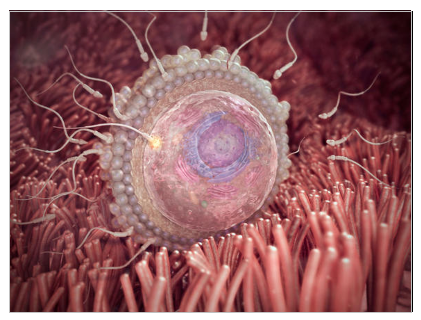
Implantation is the point at which the child attaches itself to the mother’s uterus.
Implantation is the point at which the earliest stage of the new child, the blastocyst, embeds itself into the wall of the uterus. This is the stage with which this writing is largely concerned because it is at this stage that hormonal birth control containing the progesterone hormones may cause a chemical abortion. (See the figure below)
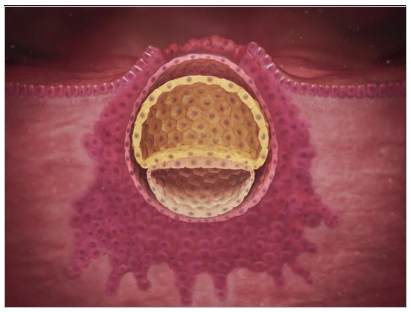
Hormonal in the term hormonal birth control, refers to the chemicals which alter the female body and/or it’s processes and birth control is any means that seeks to prevent conception.
Pre-conception is any method of birth control that prevents conception from taking place. These are sometimes hormonal methods, barrier methods, natural family planning, and barrier methods.
Post-conception is any method that prevents the then existing pregnancy from going forward. This can be a hormonal method, Intrauterine device (IUD) [sometimes a copper insert], the “Plan B” pill or morning after pill, physical abortions involving surgical equipment and an abortion practitioner, or other chemical methods. There are also self-induced abortion methods such as drinking alcohol in abundance until the baby dies, or purposefully causing physical trauma to the area of the body where the baby is growing. This is not an exhaustive list but it provides enough examples to satisfy the definition. The fact is this: All pre-conception methods are birth control but not all birth control methods are pre-conception, some are abortive.
There may be other terms that will be defined as we go, and the ones given are simple but important for the discussion. The second goal, although the priority and reason for writing, is to convince those who are using the discussed methods to stop immediately and seek a homicide risk free method of birth control.
The goals of the article will be accomplished by presenting adequate scientific evidence and doctors statements regarding the effects of hormonal birth control on the female body. We will discuss the history of hormonal birth control, the hormones themselves, the methods of delivery used, the common ignorance on the subject that makes it a mostly unseen moral crisis, the ethical problem, how one may react to the problem when they are informed or discover it exists, what choices they may make regarding the problem, and alternatives to using the current hormonal birth control options.
THE PROBLEM
Stated briefly, the problem is that certain hormones contained within modern birth control treatments, such as pills, patches, IUDs, and injections directly cause children in the first week of their lives to die inside the mother’s body. This is not the only problem that must be faced while studying this subject
There is the problem of the terms being changed, in particular the term conceive or conception. The term was changed in 1965 by the American College of Obstetrics and Gynecology.
Although the American College of Obstetrics and Gynecology in 1965 attempted to redefine “conception” to mean implantation rather than fertilization, medical dictionaries and even English language dictionaries both before and after 19665,6define “conception” as synonymous with fertilization (sometimes via the intermediary term of “fecundation”). Moore’s 1974 edition of a human embryology textbook states that development is a continuous process that begins when an ovum is fertilized by a sperm and ends at death. It is a process of change and growth that transforms the zygote, a single cell, into a multicellular adult human being. Moore’s 2008 edition emphasizes that development does not end at birth but extends into early adulthood.1Professor Emeritus of Human Embryology of the University of Arizona School of Medicine, Dr. C. Ward Kischer, affirms that “Every human embryologist, worldwide, states that the life of the new individual human being begins at fertilization (conception).” Even authors who philosophically lean towards not attributing the same value to human life at the one-cell stage as they do to later stages of development admit that “As far as human ‘life’ per se, it is, for the most part, uncontroversial among the scientific and philosophical community that life begins at the moment when the genetic information contained in the sperm and ovum combine to form a genetically unique cell (Dr. Fred de Miranda,
The problem is that one can ask his doctor or obstetrician if a particular method of birth control carries the risk of abortion and depending on that doctor’s education, bias, or ignorance on the issue, he may give a convoluted answer. The sophistry that the American College of Obstetrics and Gynecology has engaged in has fooled its own doctors in the succeeding generations into accepting the medical consensus as fact. In turn, many people without any medical background or education on the topic fail to connect the dots. They simply accept the doctor’s statement that it will not prevent conception at face value without every knowing to ask the question, “what does conception mean?” or to ask the doctor: “Is your definition of conception the point of fertilization?” The prior authors suggested a reason as to why this was done.
If ACOG ever published a rationale for this change, the American College of Pediatricians has been unable to find it. However, two physicians associated with Planned Parenthood shed some light upon a probable rationale. At the 1959 Planned Parenthood/Population Council symposium, Dr. Bent Boving argued for changing the definition by moving the date of conception fromwhen fertilization occurs towhen implantation occurs. He said that “the social advantage of [birth control] being considered to prevent conception rather than to destroy an established pregnancy could depend upon something so simple as a prudent habit of speech.”1 Bent Boving, “Implantation Mechanisms,” in Mechanics Concerned with Conception, ed. C.G. Hartman (New York: Pergamon Press, 1963), p. 386 (Ibid)
The change of definition was done to accommodate the rise of chemical birth control. The doctors who advocated for this type of birth control did so without any regard for the homicidal consequences of the new drugs that would eventually be used. This was during the beginning of the legal abortion era and the terminology had to be changed if they were going to market these new methods of birth control to women and couples who had a conscience not to kill their children, even if they were not in the ideal circumstances they wanted to be in before having them. This is the same reason the issue is almost never spoken of outside young couples who are seeking to educate themselves on the issue and make their own ethical decisions as best they can without much, if any, moral preparation on the subject.
Anyone attempting to educate others on the subject must start with the definition of conception. It will be impossible to gain any moral ground with anyone who does not carry the same definition of the word and it is largely untaught. It is the hope of those who advocate abortion to push the point of conception, and the idea of human life that is associated with it, as far forward in the pregnancy as possible.
WHEN DOES LIFE BEGIN?
Because of the nature of the contention against hormonal birth control, a more detailed explanation of when life begins must be undertaken. The following quotes are from the research work of The National Association for the Advancement of Preborn Children with the original sources cited in this article just as they cited them in theirs. The testimony of the doctors and their argumentation is important in establishing the grounds of the ethical issues dealt with in this presentation of material. The use of the term conception in the following quotes is, in their contexts, referring to fertilization and that will be directly observable in several of the quotes.
I have learned from my earliest medical education that human life begins at the time of conception…. I submit that human life is present throughout this entire sequence from conception to adulthood and that any interruption at any point throughout this time constitutes a termination of human life…. I am no more prepared to say that these early stages [of development in the womb] represent an incomplete human being than I would be to say that the child prior to the dramatic effects of puberty…is not a human being. This is human life at every stage (Report, 97thCongress 1stsession 1981).
Dr. Jerome LeJeune, professor of genetics at the University of Descartes in Paris, was the discoverer of the chromosome pattern of Down syndrome. Dr. LeJeune testified to the Judiciary Subcommittee, “after fertilization has taken place a new human being has come into being.” He stated that this “is no longer a matter of taste or opinion,” and “not a metaphysical contention, it is plain experimental evidence.” He added, “Each individual has a very neat beginning, at conception” (Ibid).
Professor Hymie Gordon, Mayo Clinic: “By all the criteria of modern molecular biology, life is present from the moment of conception” (Ibid). Note some further quotes:
Professor Micheline Matthews-Roth, Harvard University Medical School: “It is incorrect to say that biological data cannot be decisive…. It is scientifically correct to say that an individual human life begins at conception…. Our laws, one function of which is to help preserve the lives of our people, should be based on accurate scientific data” (Ibid).
Dr. Watson A. Bowes, University of Colorado Medical School: “The beginning of a single human life is from a biological point of view a simple and straightforward matter—the beginning is conception. This straightforward biological fact should not be distorted to serve sociological, political, or economic goals” (Ibid).
A prominent physician points out that at these Senate hearings, “Pro-abortionists, though invited to do so, failed to produce even a single expert witness who would specifically testify that life begins at any point other than conception or implantation. Only one witness said no one can tell when life begins” (Landrum Shettles and David Rorvik 113).
Ashley Montague, a geneticist and professor at Harvard and Rutgers, is unsympathetic to the pro-life cause. Nevertheless, he affirms unequivocally, “The basic fact is simple: life begins not at birth, but conception” (Montague 1977).
In his film, “The Silent Scream,” Nathanson later stated, “Modern technologies have convinced us that beyond question the unborn child is simply another human being, another member of the human community, indistinguishable in every way from any of us.” Dr. Nathanson wrote Aborting America to inform the public of the realities behind the abortion rights movement of which he had been a primary leader.5 At the time Dr. Nathanson was an atheist. His conclusions were not even remotely religious, but squarely based on the biological facts (Nathanson 291).
Dr. Landrum Shettles was for twenty-seven years attending obstetrician-gynecologist at Columbia-Presbyterian Medical Center in New York. Shettles was a pioneer in sperm biology, fertility, and sterility. He is internationally famous for being the discoverer of male- and female-producing sperm. His intrauterine photographs of preborn children appear in over fifty medical textbooks. Dr. Shettles states, I oppose abortion. I do so, first, because I accept what is biologically manifest—that human life commences at the time of conception—and, second, because I believe it is wrong to take innocent human life under any circumstances. My position is scientific, pragmatic, and humanitarian (Shettles and Rorvik 103).
The changes occurring between implantation, a six-week embryo, a six-month fetus, a one-week-old child, or a mature adult are merely stages of development and maturation. The majority of our group could find no point in time between the union of sperm and egg, or at least the blastocyst stage, and the birth of the infant at which point we could say that this was not a human life (Willke 1988).
Physicians, biologists, and other scientists agree that conception marks the beginning of the life of a human being—a being that is alive and is a member of the human species. There is overwhelming agreement on this point in countless medical, biological, and scientific writings (Report 97thCongress 1stsession 1981).
The quotes found above show a consensus among doctor’s contrary to the definition the American College of Obstetrics and Gynecology sets forth. The above definitions from so many doctors is boldly defended as a scientific fact and is established by empirical evidence. Human life indeed starts at the point of fertilization and that this is the true idea of conception.
A BIBLICAL DEFINITION OF WHEN LIFE BEGINS
While there is no passage that says clearly that there is a point at which a sperm meets with an egg and then gives that as the definition, there are passages that speak of children in the womb before they are born and speak of conception. In other words, although it does not explicitly define fertilization, the Bible shows God’s definition of those who are still in the womb as being children, and not just a mass of cells as some allege.
“And Adam knew Eve his wife; and she conceived, and bare Cain, and said, I have gotten a man from the Lord” (Genesis 4:1) Adam and Eve had sex, a child was conceived and then she gave birth. “And the angel of the Lord said unto her, Behold, thou art with child, and shalt bear a son, and shalt call his name Ishmael; because the Lord hath heard thy affliction” (Genesis 16:11). Hagar was with child before she ever bore him. Conception is before birth, God calls them children before they are born. “And it came to pass, that, when Elisabeth heard the salutation of Mary, the babe leaped in her womb; and Elisabeth was filled with the Holy Ghost:” (Luke 1:41).
METHODS
One focus of this article is on methods, particularly those that carry the risk of an abortion along with their preventative measures. We have already seen what should be adequate evidence to the fact that human life, individuality, and the development to adulthood that continues through the next couple of decades begins at the point at which a male sperm cell and female egg cell unite, creating a unique set of DNA that begins constructing that person immediately.
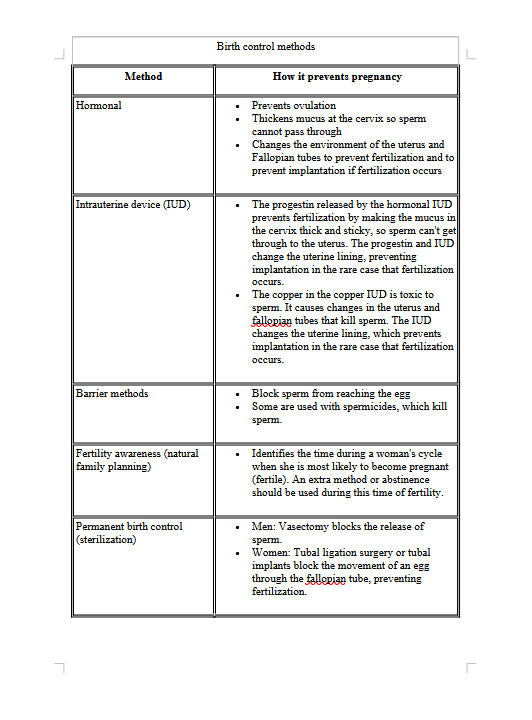
Therefore, this section will outline several common methods of birth control with their name, and the means by which it operates. There are several methods used. These include Hormonal birth control such as the birth control pill, Intrauterine device or (IUD) which is sometimes combined with hormones, the barrier methods such as the male condom or female condom and diaphragm, Fertility awareness or the planning method, and finally the sterilization method. Not all of these methods carry the potential for abortion but since we are going to discuss alternatives to the methods that carry a risk of abortion, they are listed as well. At the end of this article is a chart found on the well-known medical information website known as WebMD. It summarizes each commonly used method. You will notice that one of the headings in the chart is stated as “How it prevents pregnancy”, which is a misnomer for some of the solutions they propose, given the definition of conception we are using, that conception is the point at which an egg is fertilized. Their definition is, of course, the changed definition given by the American College of Obstetricians and Gynecologist, that is that conception is implantation.
Hormonal Method:
This method is and/or can be both a pre-conception method or a post-conception method of birth control. Anyone can at any time do extensive research online and with their doctor to find a hormonal method that is estrogen only but they will fail. The significance in the previous statement is that there currently exist only combined methods with estrogen and progesterone and it is the progesterone treatment that thins the uterine wall, giving the risk of an abortion occurring due to the hormonal method. Prior to the progesterone being introduced into the popular hormonal methods estrogen only was used. The issue was that in significant enough doses to completely stop ovulation, estrogen also carried deadly risks in some women. These risks are well known and mentioned on nearly every hormonal birth control advertisement today, or on the packaging. Risks such as heart attack, stroke, and blood clots. In order to combat those risks, they lowered the dose of estrogen in each pill but that allowed occasional breakthrough ovulation periods. Their solution was to introduce another hormone into the pill, progesterone. The progesterone thickens the mucus found in the cervix, making it harder for sperm to penetrate and stopping fertilization but it also thins the wall of the uterus, causing the developing child to not be able to attach him or herself to the mother to gain the nutrients she is supposed to provide to her children, and thus, due to the hormones, the child is aborted. Below is a statement from Richard Hill in a conversation with a pro-life advocate found on
. Richard Hill is a pharmacist in the product information department of Ortho-McNeil,
“Oh, no, it’s not theoretical. It’s observable. We know what an endometrium looks like when it’s rich and most receptive to the fertilized egg. When the woman is taking the Pill, you can clearly see the difference, based both on gross appearance – as seen with the naked eye – and under a microscope. At the time when the endometrium would normally accept a fertilized egg, if a woman is taking the Pill it is much less likely to do so” (Richard Hill,
The fact is printed on many of the products and explicitly states that the thinning of the endometrium is used as a third method of stopping implantation. It is no secret that hormonal birth control creates a risk of abortion. Commonly reported failure rates for products range between 1-5%, or in other words, 1-5% of the time pregnancy still occurs while being treated with the most popularly known method, the Pill. That means that there are an untold number of breakthrough ovulations that do happen to become fertilized but fail to attach to the mother because of the purposeful thinning of the endometrium.
The IUD:
This method operates on the same principle as the hormonal method. In some cases, it is both a hormonal method and a copper method. The result is the same. It, if it carries hormones, prevents ovulation, changes the physical characteristics of the uterus and thins the endometrium, preventing implantation, and thus, in certain circumstances causes an abortion.
Barrier Methods:
These are methods that physically block the sperm from reaching the egg. In all forms of this method it is nothing more than contraception. It does not carry the risk of an abortion. The common male condom is one example but there are female barrier methods as well.
Fertility awareness:
By tracking menstrual cycles and ovulation weeks a woman can form an educated guess as to the best time to become pregnant and contrary wise when she is the least likely to become pregnant. There is no risk of an abortion.
Permanent Birth Control:
Sterilization carries no risk of abortion. It is also the most drastic because there may be no going back when this step is taken. There are times when this method is utilized but the body finds a way to repair the damage done or the knot tied by the surgeon coming undone.
CONCLUSION
For the Christian, simply realizing that you may possibly be destroying your children for the sake of convenience or comfort should be enough to repent of the negligence in which you have been indulging. After learning that you are risking the life of children you can only be held to that much higher a standard of amenability. The choose to remain in a state of ignorance does not remove the sin of murder or the responsibility for the deaths of any children who may have been conceived but aborted because of the post-conception birth control method used any more than remaining ignorant of God’s law excuses you from it, or remaining ignorant of the Gospel excludes your need to obey it.
Through the hours spent looking online, talking to others who have done the research, looking at doctor’s statements regarding hormonal birth control, the only conclusion is that while it is possible to create one that carries no risk of abortion, there are no companies actively making one that carries no risk. The only treatments that do not contain the endometrium altering hormones are only offered to women who have had a hysterectomy performed or are going through menopause. Those treatments are not designed for, meant for, or prescribed for birth control. Every hormonal method available today is either the combined hormonal method of estrogen and progesterone or something like the “mini-pill” which is progesterone only. The “mini-pill” and other progesterone only methods are directly aimed at aborting any pregnancy that begins before it can sustain itself on the nutrient rich uterine wall by attaching and beginning the first step of the umbilical cord.
There are going to be many diverse reactions to those who you may confront with the information. One common negative reaction is to outright reject the notion that it is even possible, yet it is printed directly on the packaging for many of these products. A quick search on even a popular main stream website such as WebMD will provide anyone with the basic information of how these products “prevent” pregnancy. A clear question to any doctor as to whether or not these products might prevent implantation can make it easier for those who appeal to their personal doctor as if all the evidence and the doctors peers know nothing about the subject. The question to be asked should be, “Does this product prevent implantation in the event of fertilization?” The answer will be yes if they are honest and tell the truth. It would take a total fabrication for them to say otherwise, but they will not do that since they have been told the definition of conception is implantation. That is why a simple question such as “will this abort the baby after conception?” is not sufficient. If you are trying to determine the validity of the claims found in this article, you can ask your doctor those questions and seek what the answer is, you can search online and find a multitude of information from studies, images, and doctors who understand what is going on with the modern rhetoric. You can also check the information that comes with a prescription of these drugs, look at the pharmaceutical companies’ product description page online, and a variety of other sources can be searched to confirm the claims. They are not farfetched, nor hidden. It is simply the case that we are not talking about the issue outside of a few good men and women and young couples seeking information on the subject.
If we are wondering why we are fighting such an uphill moral battle in the US, part of the answer is because God’s own people are killing their children and do not know it, or have had a clue given to them but refuse to pursue it because of the implications it means for them. There are children being flushed down the toilet without their mothers ever having known they existed, without even the faintest shred of human sympathy, and certainly with the smallest voice coming from the almost non-existent group of advocates fighting for their survival. Literally, no one can care if they do not know and almost no one knows, and few of those who do know are willing to break the uncomfortable ice.
Works Cited
Ashley Montagu, Life Before Birth (New York: Signet Books, 1977
Bernard N. Nathanson, “Deeper into Abortion,” New England Journal of Medicine 291 (1974)
Bernard Nathanson, Aborting America (Garden City, NY: Doubleday, 1979)
“How Birth Control Methods Prevent Pregnancy – Topic Overview.” WebMD, WebMD,
www.webmd.com/sex/birth-control/tc/how-birth-control-methods-prevent-pregnancy-topic-overview
.
John C. Willke, Abortion Questions and Answers (Cincinnati, OH: Hayes Publishing, 1988)
Miranda, Fred de, and Patricia Lee June. “When Human Life Begins.” American College of Pediatricians, 17 Apr. 2017,
www.acpeds.org/the-college-speaks/position-statements/life-issues/when-human-life-begins
.
Report, Subcommittee on Separation of Powers to Senate Judiciary Committee S-158, 97th Congress, 1st Session 1981.
Landrum Shettles and David Rorvik, Rites of Life: The Scientific Evidence of Life Before Birth (Grand Rapids, MI: Zondervan Publishing House, 1983), 113
Life, Texas Right to. “Did You Know That Some Birth Control Methods Can Cause Abortion?” Texas Right to Life, 1 Feb. 2017,
www.texasrighttolife.com/did-you-know-that-some-birth-control-methods-can-cause-abortion/
.
“Pregnancy and Conception.” WebMD, WebMD,
www.webmd.com/baby/understanding-conception#1
.
Report, Subcommittee on Separation of Powers to Senate Judiciary Committee S-158, 97th Congress, 1st Session 1981, 7
Shettles and Rorvik, Rites of Life, 103
Leave a Reply